
Common Mistakes in Millet Cooking, and How to Fix Them
What if the same millet that turns mushy in one pot could cook up fluffy and distinct in another? It’s frustrating when grains come out dry, bland, or unevenly cooked, especially when water ratios and soaking advice vary from one millet to the next. These common mistakes in millet cooking often come from using a one-size-fits-all method for grains with different needs.
A few thoughtful adjustments can make millet more reliable. Learn what causes mushiness, dryness, and flat flavour, and how rinsing, soaking, heat, and resting affect the result. You’ll also see how to choose a cooking approach for the grain and dish you have in mind, from fluffy kernels to a softer, spoonable consistency.
Then put the guidance to work with two approachable recipes featuring precise measurements. With grain-specific methods and a little kitchen know-how, millet can become a dependable part of everyday cooking.
Key Takeaways
- Learn to read mushy grains, hard centres, and flat flavour as clues to what needs adjusting.
- See why common mistakes in millet cooking often come from applying the same preparation method to different grains.
- Find out how rinsing, soaking, and choosing the right amount of liquid can help create the texture you want.
- Use practical troubleshooting steps to rescue firm or sticky millet, then make a more informed adjustment next time.
- Try two measured recipes and build a repeatable routine for more confident millet cooking.
Common Mistakes in Millet Cooking: Why Results Turn Mushy, Dry, or Bland
An imperfect batch is useful feedback, not proof that millets are difficult to cook. A pot that turns mushy, has firm centres, or tastes flat points to the grain, its preparation, or the cooking method. The common mistakes in millet cooking become easier to correct when you treat texture as a clue rather than a verdict.
Start by naming what happened. Mushy millet has lost its distinct shape and may feel sticky or waterlogged. Hard-centred millet is still firm or chalky inside, often because it needs more cooking liquid or time. Muted flavour means the grain tastes dull, perhaps because it was underseasoned or the dish missed flavour-building steps. Each symptom can have more than one cause, so a single water ratio won’t explain every result.
What does perfectly cooked millet look and feel like?
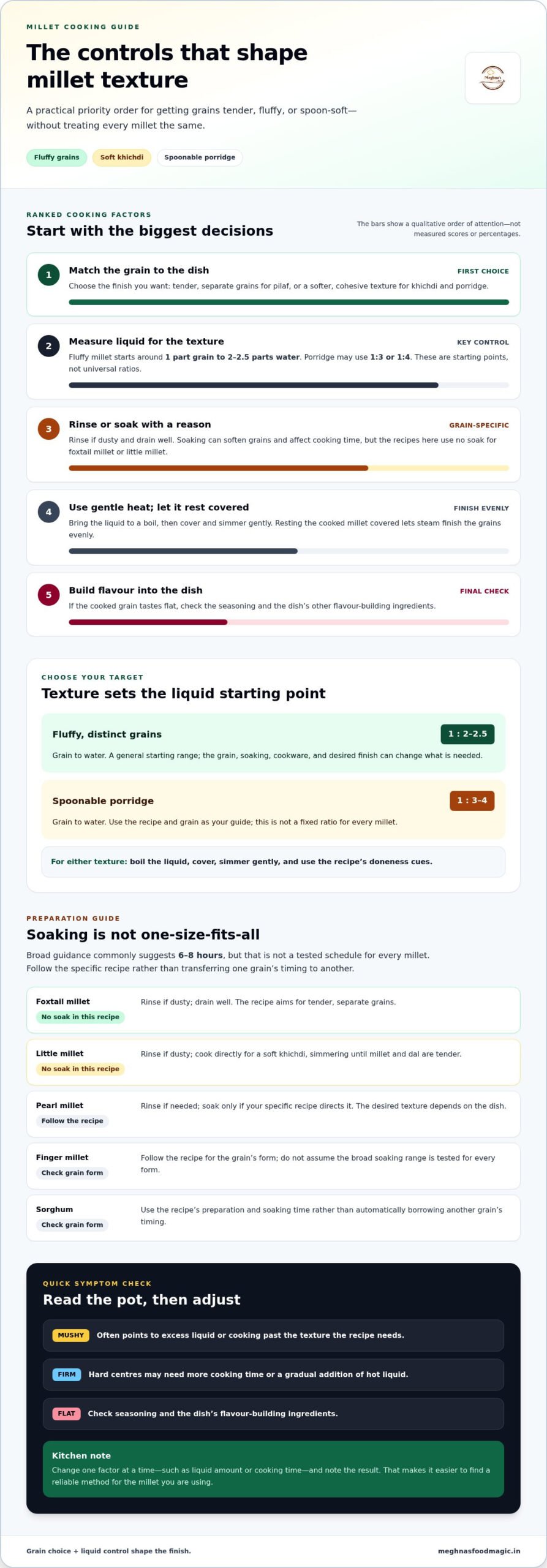
For a pilaf-style dish, cooked grains should be tender but separate enough to mix with vegetables or spices without turning into a paste. For porridge or khichdi, a softer, more cohesive texture may be exactly right. There’s no single ideal finish: the recipe sets the target. In short, grain choice and liquid control shape millet texture.
Why does one millet cooking rule fail across every grain?
Foxtail, little, pearl, and finger millets, along with sorghum, are distinct ingredients, not interchangeable versions of rice. Millet refers to a highly varied group of small-seeded grasses, and the grain you buy may be whole, cracked, or milled. Size and form affect how it cooks, as does whether you want separate grains, soft khichdi, or porridge. That’s why soaking and cooking times shouldn’t be assumed to match across varieties.
Use this symptom check as a starting point. The next sections explain how to fine-tune the method for your grain and dish.
- Mushy: Too much liquid or cooking beyond the texture the recipe needs.
- Hard centres: The grains may need more time or a gradual addition of hot liquid.
- Flat flavour: The seasoning or other flavour-building ingredients may need attention.
Change one factor at a time, such as the liquid amount or cooking time, and note the result. That simple kitchen experiment helps you find a reliable method for the millet you’re using.
Rinsing, Soaking, and Water Ratios: Match the Method to the Millet
Rinsing, soaking, and measuring liquid serve different purposes. Rinsing removes surface dust or debris when present; it won’t correct a waterlogged or overcooked batch. Soaking can soften grains and affect cooking time, while the amount of liquid helps determine whether the finished dish is fluffy or soft. Match each choice to the grain and recipe instead of treating it as a fixed rule.
Should you rinse or soak millet before cooking?
Rinse millet if it looks dusty, then drain it well so leftover rinse water doesn’t alter your measured liquid. Soaking depends on the recipe. Broad guidance commonly suggests 6-8 hours, but that isn’t a tested schedule for every millet. The two recipes in this guide don’t require soaking: the foxtail method aims for separate grains, while the little millet khichdi is cooked directly for a softer finish.
| Grain | Preparation choice | Desired texture | Timing guidance |
|---|---|---|---|
| Foxtail millet | Rinse if dusty; no soak for the fluffy recipe here | Tender, separate grains | No soaking; follow the recipe’s cooking time and doneness cues |
| Little millet | Rinse if dusty; no soak for the khichdi recipe here | Soft and cohesive | No soaking; simmer until the millet and dal are tender |
| Pearl millet | Rinse if needed; soak only if your specific recipe directs | Set by the dish | Use the recipe’s soaking time; 6-8 hours is broad guidance, not a verified grain-specific timing |
| Finger millet | Follow the recipe for the grain’s form | Set by the dish | Use the recipe’s soaking time; don’t assume the broad 6-8-hour range is tested for every form |
| Sorghum | Follow the recipe for the grain’s form | Set by the dish | Use the recipe’s soaking time; don’t transfer another grain’s timing automatically |
How do you choose the right water ratio and cooking heat?
Fluffy grains need enough liquid to become tender without turning soft. Porridge and khichdi need more liquid for a spoonable consistency. A general starting range for fluffy millet is 1 part grain to 2-2.5 parts water, while porridge may use 1:3 or 1:4. These are starting points, not universal ratios. Grain, soaking, cookware, and the texture you want all affect the amount needed.
Bring the liquid to a boil, then cover and simmer gently. Rest the cooked millet covered if you want steam to finish the grains evenly. Incorrect liquid measurement is a frequent source of mushy or dry results, as Mashed explains in its discussion of millet cooking. For visual examples of grain-specific preparation, explore millet cooking videos.
Millet Troubleshooting: Fix Mushy, Hard, Sticky, or Bland Results
A batch that misses the mark isn’t wasted. The best fix depends on whether the grains are firm, already too soft, or simply lacking flavour, and on whether the dish should be fluffy or spoon-soft. These practical adjustments address common mistakes in millet cooking without expecting every grain to behave the same way.
| Symptom | Likely cause | Immediate fix | Next-batch adjustment |
|---|---|---|---|
| Firm or hard centres | Not enough liquid or cooking time for that grain and method | Add a little hot liquid, cover, and continue cooking gently. Check again before adding more. | Allow for the grain’s preparation and test doneness before ending the cook. |
| Mushy grains | Excess liquid or cooking beyond the desired texture | Stop adding liquid. Serve as porridge or repurpose in a dish suited to soft grains, such as patties. | Reduce liquid or cooking time for the same grain and texture goal. |
| Sticky, clumped grains | Stirring too much or using a softer method when aiming for a fluffy finish | Stop stirring and assess the texture. If it’s very soft, use it in a dish where cohesion is welcome. | Stir less during cooking and follow a method designed for separate grains. |
| Bland millet | Underseasoning or cooking in plain liquid without flavour-building ingredients | Adjust seasoning while the dish is warm; add suitable aromatics or flavourful accompaniments. | Season the cooking liquid and build flavour with aromatics that suit the recipe. |
How can you rescue undercooked or mushy millet?
If the centre is firm, don’t pour in a large amount of water at once. Add hot liquid gradually, cover the pot, and continue over low heat, checking the grain between additions. This gives the millet time to absorb moisture without leaving it swimming in liquid. The amount it needs depends on the grain, how it was prepared, and the dish you’re making.
Already-soft grains won’t return to a separate, fluffy texture. Stop cooking and use them another way. Porridge can welcome extra softness; patties can make use of grains that hold together. Choose a rescue that suits the batch’s texture instead of trying to force it back into a pilaf.
Why does cooked millet taste bland or turn sticky?
For more flavour, consider the whole cooking process: season the liquid and use aromatics suited to the dish. Salt or spices added only at the end may not give the same rounded taste. Seasoning won’t correct a texture problem, so address excess liquid or overcooking separately.
Frequent stirring can break grains down and make them stick together. For fluffy millet, leave the pot undisturbed as it cooks, then rest it covered if the recipe directs. If it’s a little moist and you want a drier finish, resting uncovered can let steam escape. In khichdi or porridge, a soft, cohesive result may be the goal, not a mistake.
Two Measured Millet Recipes That Put Better Cooking Habits into Practice
These two recipes have different texture goals: the first keeps foxtail millet fluffy and separate, while the second embraces the soft, comforting consistency of khichdi. Use the measurements as written and judge doneness by the grain rather than making both dishes follow the same method. That’s a practical way to put lessons about common mistakes in millet cooking into action.
Fluffy foxtail millet
Serves: 2
Ingredients
- ½ cup foxtail millet
- 1 cup water
- 1 teaspoon oil
- ¼ teaspoon salt
Method: Rinse the millet in a fine-mesh sieve and drain it thoroughly. This removes surface dust or debris and keeps rinse water from changing the measured liquid. This version doesn’t require soaking, so the water amount stays straightforward. Bring the measured water, oil, and salt to a boil. Stir in the millet, cover, and reduce the heat to a gentle simmer. Cook until the grains are tender and the water has been absorbed, checking for doneness rather than relying on a fixed time. Turn off the heat and rest, covered, for 5-10 minutes. The grains should look plump and separate easily when fluffed with a fork. Serve alongside dal, vegetables, or a curry.
Little millet and moong dal khichdi
Serves: 2
Ingredients
- ½ cup little millet
- ¼ cup moong dal
- 2½ cups water, plus extra hot water as needed
- 1 tablespoon ghee
- ½ teaspoon cumin
- ¼ teaspoon turmeric
- ½ teaspoon salt
Method: Rinse the millet and dal separately, then drain well to remove surface debris. This recipe uses them without soaking; soaking either ingredient may change its cooking time and liquid needs. Warm the ghee in a pot and add the cumin. Once fragrant, stir in the turmeric, rinsed millet, dal, water, and salt. Bring to a boil, then cover and simmer gently until both grains are soft. If they remain firm as the liquid is absorbed, add hot water a little at a time and continue cooking. Rest covered briefly before serving. For a looser khichdi, stir in more hot water gradually; for a thicker bowl, use less. Serve warm with your preferred accompaniments.
For more grain-selection ideas and millet dishes, browse the free millet recipe collection.
Chef Meghna’s Notes: Build Confidence with Millet Cooking
Millet cooking gets easier when you treat each batch as a small lesson. The grain, its form, and the texture you want all shape the method. Keep the process steady, then adjust based on what you observe. A disappointing result can show you what to change next time.
Substitutions and small adjustments
Millets aren’t automatic one-for-one substitutes. Swap one for another only when the recipe has been tested with both, since a grain change can affect liquid needs, cooking time, and texture. When trying a new grain, start with a small batch.
For more flavour, use broth as the cooking liquid or add aromatics that suit the dish. Neither replaces careful liquid measurement. If the grains are still firm, add hot liquid gradually and continue cooking gently. If they’re already very soft, serve them in a dish that welcomes a softer texture instead of expecting them to become fluffy.
Keep a quick cooking note: record the grain and quantity, soak duration, liquid amount, and cooking time. This makes it easier to repeat a result you like and identify what to adjust next time.
A simple routine for your next millet batch
Start with a small batch and follow a method intended for that grain and dish. Then work through these steps:
- Identify the grain: Note whether it’s whole, cracked, or processed.
- Choose the texture: Decide whether you want distinct grains or a softer khichdi or porridge.
- Measure and cook gently: Follow the recipe’s liquid guidance and keep the pot at a gentle simmer.
- Check doneness: Use the recipe’s timing as a guide, then taste for tenderness and the texture you want.
For visual demonstrations, explore the millet cooking video collection. If you’re planning another grain-based meal, browse Jowar recipes for ideas.
Make Your Next Millet Batch a Confident One
Better millet starts with matching your method to the grain and the dish. Choose the texture you want, measure the liquid for that specific recipe, and cook gently. Rinsing can clear away surface dust, while soaking is a recipe-dependent choice, not a universal rule.
If the grains turn out firm, add hot liquid gradually and keep cooking gently. If they’re already soft, give them a new role in a dish that welcomes a softer texture. For bland results, build flavour with seasoning and aromatics while keeping liquid control in check. The common mistakes in millet cooking are easier to learn from when you adjust one detail at a time.
Start with a small batch, notice how the grains look and feel, and jot down what worked. Meghna’s Food Magic offers a free digital recipe database with millet recipes and cooking content, alongside visual guidance on its YouTube channel.
Every pot is a chance to learn. Keep experimenting, and let the next batch bring a little more confidence to your kitchen.
Frequently Asked Questions
Why does millet turn mushy when I cook it?
Millet often turns mushy when it absorbs more liquid or cooks longer than the recipe’s texture requires. Stirring frequently can also break down the grains and make them sticky. The right amount of liquid depends on the millet, whether it was soaked, the cookware, and whether you’re making fluffy grains or soft khichdi. These common mistakes in millet cooking are easier to correct when you adjust one factor at a time.
Do you need to soak millets before cooking?
No, soaking isn’t required for every millet recipe. Some methods cook the grain directly, while others call for soaking to soften it and may reduce cooking time. Follow the instructions for the specific grain and dish, and drain soaked millet well before measuring or adding cooking liquid. If you change the preparation, expect the cooking time and texture to differ from the recipe’s result.
How long should I soak millets before cooking?
There isn’t one soaking time that suits every millet. A general reference is 6-8 hours, but use it only when it fits the grain and recipe; some recipes don’t require soaking. Soaking can soften the grain and affect how quickly it cooks, so drain it thoroughly and follow the recipe’s liquid guidance. Don’t assume foxtail, little, pearl, or finger millet all need the same soak.
Should I rinse millet before cooking it?
Rinse millet if you notice surface dust or debris, then drain it well. A fine-mesh sieve helps keep the small grains from escaping. Rinsing is a cleaning step, not a guaranteed fix for mushiness or stickiness; liquid, cooking time, and stirring have more effect on those results. If the recipe specifies a dry-toast step, follow its directions and avoid adding unmeasured rinse water to the pot.
How do I cook millet so the grains stay fluffy?
For fluffy millet, choose a recipe intended to produce separate grains and measure its liquid carefully. Bring the pot to a boil, then cover and simmer gently without frequent stirring. Once tender, remove it from the heat and let it rest covered as directed, then fluff gently with a fork. Grain type and preparation affect the result, so don’t transfer one millet’s timing or liquid amount automatically to another.
Can I fix millet that is still hard after cooking?
Yes. If the grains are still firm, add a small amount of hot water, cover the pot, and continue cooking over low heat. Check the texture before adding more, so the millet doesn’t become waterlogged. The amount of extra liquid and cooking time depends on the grain and method. Stop once the centres are tender and suit the dish, whether that means distinct grains or a softer consistency.
What is the correct water ratio for cooking millet?
There’s no single correct ratio for every millet and dish. For fluffy grains, 1 part millet to about 2-2.5 parts water is a general starting range, while porridge may need more liquid, around 1:3 or 1:4. Treat these as starting points, not universal rules. Soaking, grain form, cookware, and the desired consistency all affect how much liquid the recipe needs.
Disclaimer
This is a recipe food blog page and not nutrition or doctor and hence do not claim to cure any illness. If you have specific health issues please consult a qualified doctor or certified nutritionist.
I do consult experts, research Internet and at times seek help from Gemini to collect relevant information to put together some of these blogs.

