
Best Pot Brands in India for Healthy & Efficient Cooking
The most familiar pot brand may not be the best match for your everyday cooking. A pot that simmers dal beautifully may not be the one you’d choose for a quick sabzi or a slow-cooked tomato curry. If you’re comparing the Best utensil brands in Indian market – pots included, start with what you cook, not just the name on the lid. Terms such as tri-ply, hard-anodised, and ceramic describe materials or construction, but they don’t tell you how a specific pot will perform on your stove.
This guide makes the choice practical. Learn how common pot materials suit Indian cooking, what to check for heat distribution, maintenance, and induction use, and how to compare brands such as Hawkins, Prestige, Vinod, The Indus Valley, and Stahl Kitchens using consistent criteria. The goal isn’t to crown one pot for every kitchen. It’s to help you find a dependable fit for your recipes and cooking habits. Start with the cooking task, then match the material and brand to it.
Key Takeaways
- Match a pot’s shape, capacity, lid, handles, and base to the dishes you cook most often, not just the brand name.
- Understand how stainless steel, tri-ply, cast iron, and other materials differ in everyday use and care.
- Compare The Indus Valley, Vinod Cookware, and Stahl Kitchens using the same practical criteria when assessing the Best utensil brands in Indian market – pots.
- Use three familiar recipe tests to think through material, cooktop compatibility, capacity, and maintenance before choosing.
- Follow a simple decision path for dal and curry, rice, or occasional large-batch cooking to narrow down a pot that fits your routine.
What Makes a Good Cooking Pot for Indian Kitchens?
A useful cooking pot suits the dish, your heat source, and the way you cook day to day. The right choice makes stirring easier, helps you manage simmering and evaporation, and feels comfortable to lift and clean. A brand name can help you find options, but it can’t tell you whether a particular pot suits your recipes or kitchen routine.
Consider the difference between simmering dal, boiling pasta, cooking rice, and making curry. Dal needs room to bubble without spilling, while pasta needs enough water and space to move. Rice needs a covered vessel that can contain steam; a curry pot should leave room to stir without splashing. One pot may handle several tasks, but its capacity, depth, and shape affect how comfortably it does so. For an overview of how cookware forms and materials vary, see Cookware and bakeware materials.
Which pot shape suits everyday cooking?
A saucepan has a smaller footprint and a handle, making it handy for modest portions, sauces, or reheating. A deeper pot suits dishes with liquid and frequent stirring. A stockpot is taller and holds more, which is useful for larger batches or boiling. Pressure cookers cook under pressure, so use them according to their instructions rather than treating them as ordinary lidded pots. A kadai has sloping sides and a broad opening, giving ingredients room to move and making serving easy.
Depth and opening width affect how a dish cooks. A deeper, narrower vessel exposes less liquid to air, which can slow evaporation. A wider opening gives more room for stirring and lets moisture escape more readily. That can help when reducing a curry, but a broad pot may need more attention if its contents dry quickly. No shape suits every recipe. Choose for the texture and cooking process you want.
Which pot details deserve attention before the brand?
Start with capacity. A pot should hold your usual batch with enough room to stir, not merely fit the ingredients when cold. A well-fitting lid helps retain heat and steam, while secure, comfortable handles matter when the pot is full. Consider its weight both empty and loaded, and whether its shape will fit your storage space.
Check the base and the exact product’s cooktop compatibility before buying. A brand may offer different construction across its range, so don’t assume every pot works on induction or behaves the same way on gas. Compare the manufacturer’s stated capacity, dimensions, material, and care guidance for that specific pot.
- For dal or curry, look for room to stir and a lid that sits securely.
- For rice or pasta, consider the amount you typically cook and how easily you can drain or serve it.
- For a kadai-style task, prioritise an open shape that gives ingredients space to move.
This task-first approach makes comparisons more useful. The Best utensil brands in Indian market – pots can include options for different kitchens, but your shortlist should begin with the vessel your cooking calls for. Match the pot to the dish before comparing labels.
Pot Materials Explained: Stainless Steel, Tri-Ply, Cast Iron, and More
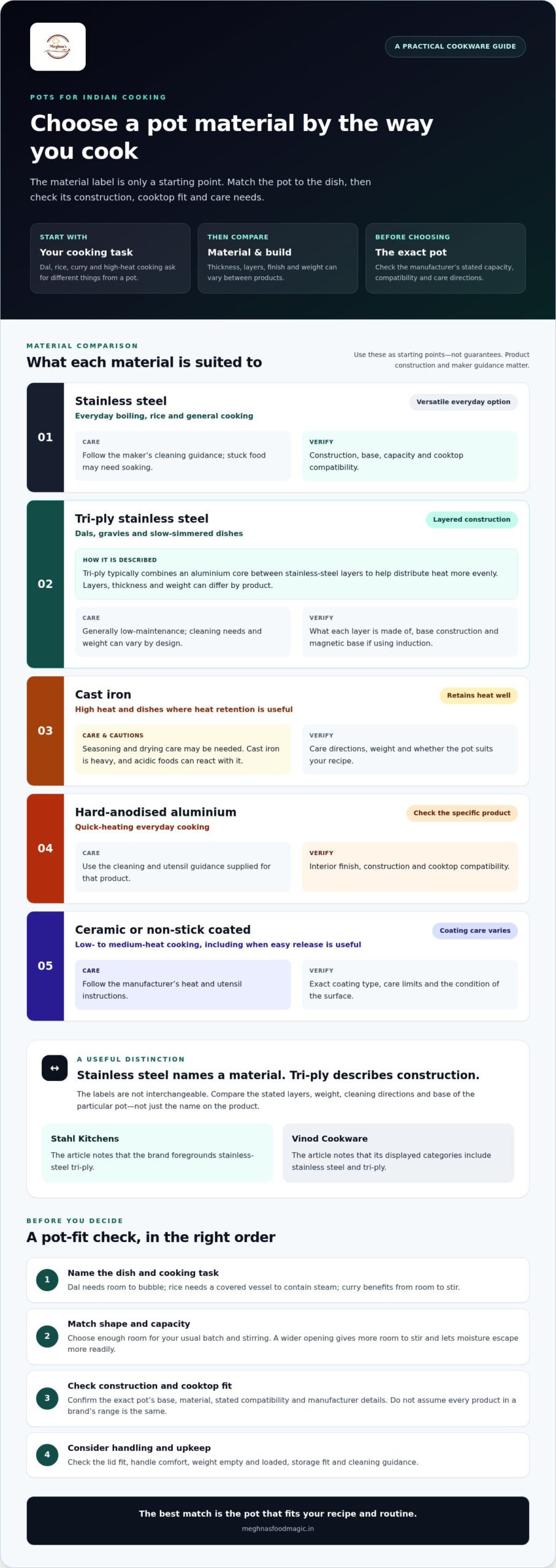
Material affects how a pot responds to heat, the texture of a dish, and the care it needs after cooking. The label is only a starting point: construction, thickness, finish, and the manufacturer’s instructions matter too. Use this comparison to narrow your options, then check the details for the exact pot you’re considering.
| Material | Likely cooking use | Care considerations | What to verify |
|---|---|---|---|
| Stainless steel | Everyday boiling, rice, and general cooking | Follow the maker’s cleaning guidance; stuck food may need soaking. | Construction, base, capacity, and cooktop compatibility |
| Tri-ply stainless steel | Dals, gravies, and slow-simmered dishes | Generally low-maintenance; designs can differ in cleaning needs and weight. | What each layer is made of, and how the base is constructed |
| Cast iron | High-heat cooking and dishes where heat retention is useful | Seasoning and drying care may be needed; acidic foods can react with it. | Care directions, weight, and whether the pot suits your recipe |
| Hard-anodised aluminium | Quick-heating everyday cooking | Use the cleaning and utensil guidance supplied for that product. | Interior finish, construction, and cooktop compatibility |
| Ceramic or non-stick coated | Low- to medium-heat cooking, including dishes where easy release is useful | Coating care varies; follow the manufacturer’s heat and utensil instructions. | Exact coating type, care limits, and condition of the surface |
How does stainless steel compare with tri-ply?
Stainless steel names a material; tri-ply describes a layered construction. A tri-ply pot typically combines an aluminium core between stainless steel layers, helping distribute heat more evenly. The layers, thickness, and weight can differ between products, even when they share the tri-ply label. Stahl Kitchens foregrounds stainless steel tri-ply, while Vinod displays several material categories, including stainless steel and tri-ply. Compare the specific pot’s stated layers, weight, cleaning directions, and magnetic base if you use induction.
When might cast iron or coated cookware suit a pot task?
Cast iron can suit high-heat cooking because it retains heat well, but it’s heavy, needs appropriate care, and may affect the taste of acidic dishes. Ceramic-coated cookware is often chosen for low- to medium-heat cooking. The term “non-stick” alone doesn’t tell you what coating is used or how to care for it. Hard-anodised aluminium heats quickly and is durable, but product construction still varies. Check product details for coating information and care instructions rather than assuming they are the same across a brand’s range.
Choose material according to the dish and your care routine. When comparing the Best utensil brands in Indian market – pots, compare equivalent materials and constructions, not just brand names. Then consider how often you’ll use the pot and whether its upkeep suits your kitchen habits. For practical cooking inspiration, explore Chef Meghna’s cooking videos.
How Do Indian Cookware Brands Compare for Pots?
A useful brand comparison starts with the cookware categories each brand offers, then focuses on the details of the individual pot. The Indus Valley, Vinod Cookware, and Stahl Kitchens each provide different starting points for comparing materials and vessel types. A category name alone won’t establish whether a particular pot suits your recipe, cooktop, or cleaning routine.
| Brand | Pot types shown | Material range shown | Published details | Reader fit to investigate |
|---|---|---|---|---|
| The Indus Valley | Cookware categories include pots | Cast iron and tri-ply cookware | The range highlights these categories and uses healthy-cookware language. | Useful to compare if you’re weighing cast iron against layered stainless steel options; choose a pot that matches your cooking task. |
| Vinod Cookware | Pressure cookers, pots, and kadais | Several categories, including stainless steel, tri-ply, cast iron, ceramic, and platinum cookware | The catalogue spans different cookware types and materials. | Useful if you want to compare vessel forms or material categories within one brand’s range. |
| Stahl Kitchens | Cookware categories include pots | Stainless steel tri-ply is foregrounded | The range gives tri-ply a central role and includes promotional positioning around precision-engineered cookware. | Consider it when comparing tri-ply pots, and match the form and capacity to your needs. |
What does each brand’s visible range suggest?
The categories point to different ways to begin comparing, not a verdict on cooking performance. The Indus Valley’s cast iron and tri-ply categories invite a material comparison. Vinod’s pressure cookers, pots, and kadais make vessel type another useful filter. Stahl Kitchens’ emphasis on tri-ply offers a clear material focus. For any brand, compare the pot’s form, capacity, and construction with the dishes you plan to cook.
How can readers compare brand claims fairly?
Separate product information from promotional wording. Terms such as “healthy,” “premium,” or “precision-engineered” describe a brand’s positioning; they don’t, by themselves, reveal a pot’s layer composition, capacity, weight, or care needs. Compare like with like: a stainless-steel pot against another stainless-steel pot of a similar form, not a pressure cooker against a kadai or a cookware bundle.
For each exact model, review the manufacturer’s stated material and construction, dimensions, cooktop compatibility, and care guidance. If a feature matters to your routine, such as a lid or a particular handle arrangement, look for it in that product’s details rather than assuming it applies across the brand. This keeps the comparison grounded in what you’ll actually use.
That’s the practical way to assess the Best utensil brands in Indian market – pots: use brand ranges to find candidates, then judge individual pots against the same cooking and care needs. No single brand needs to suit every kitchen.
A Practical Pot-Choosing Checklist, with Three Recipe Tests
Before comparing brands, test your likely pot against the food you actually cook. Follow this order:
- List regular dishes. Note whether you often simmer dal, cook rice, or make milk-based desserts.
- Identify your cooktop. Check the exact pot’s manufacturer details for compatibility; a brand’s range can include different bases.
- Choose capacity. Allow room for stirring and bubbling, and consider how much you usually prepare.
- Compare materials. Think about the heat response and upkeep that suit your recipes and routine.
- Check care instructions. Read the guidance for the exact model before buying or cleaning it.
Dimensions, usable capacity, and cooktop compatibility are product-specific. Don’t infer them from a brand name or from another pot in the same range. These three measured recipe tests show how vessel shape and lid fit affect real cooking.
Simple moong dal
- Split yellow moong dal: 100 g
- Water: 750 ml
- Turmeric: 2 g
- Salt: 5 g
Rinse the dal, then add all ingredients to a medium, deep pot. Bring to a boil, reduce to a gentle simmer, and cook uncovered for about 20-25 minutes, stirring occasionally, until the grains soften and the dal reaches your preferred consistency. This makes about 2 servings. A deeper pot gives the foam room to rise without spilling.
Steamed rice
- Basmati rice: 200 g
- Water: 400 ml
- Salt: 3 g
Rinse and drain the rice, then combine it with water and salt in a small pot. Bring to a boil, cover with a well-fitting lid, and cook on low for about 12-15 minutes. Turn off the heat and leave covered for 10 minutes; the grains should be tender and the water absorbed. Makes about 2 servings. Choose a pot that leaves room for the rice to expand without being so wide that the water evaporates too quickly.
Vegetable kheer
- Milk: 1 litre
- Rice: 50 g
- Sugar: 30 g
- Cardamom: 2 g
Rinse and drain the rice. Warm the milk in a deep, heavy pot, add rice, and simmer gently for about 35-45 minutes, stirring often, until the rice is tender and the milk has thickened. Stir in sugar and cardamom near the end. Makes about 3-4 small servings. Depth helps contain rising milk, while steady stirring keeps rice from settling and sticking.
Chef Meghna’s Notes: substitutions, troubleshooting, and care
For dal, split red lentils can replace moong, though they soften into a different texture and may cook sooner. If rice sticks, lower the heat and avoid stirring during covered cooking. If dal or milk foams, reduce the heat and use a deeper pot. For an uneven simmer, centre the pot over the burner and adjust the heat. Don’t fill it close to the rim. Clean and store each vessel according to its manufacturer’s care directions, especially if it has a coating.
Use these recipe tests to see which of the Best utensil brands in Indian market – pots offers a form and material that fits your routine.
Make Your Final Pot Choice with Confidence
A confident choice follows a simple order: cooking tasks first, then cooktop, capacity, material, care, and finally brand. This keeps attractive finishes or broad product claims from distracting you from the pot you’ll reach for most. Compare the exact model’s material, dimensions, cooktop compatibility, and care instructions before deciding. Similar labels don’t guarantee identical construction or performance.
Which buying decision fits your cooking routine?
If dal and curry are regulars, prioritise a pot with enough depth and room to stir your usual portions. A lid can help retain heat during simmering, while a manageable weight matters if you move a full pot from stove to table. Choose a pot that makes repeated meals comfortable, not simply the largest or most feature-rich option.
If rice is your main task, focus on a well-fitting lid and a capacity that suits your batch. A pot that’s too wide for a small quantity may make it harder to manage water evaporation; one that’s too small can leave little room for the rice to expand. Follow your cooking method and check the pot’s usable capacity, not just its outside dimensions.
If you cook large batches only occasionally, consider whether a stockpot or other larger vessel will earn its cupboard space. Think about where it will be stored, how heavy it will feel when full, and whether its cleaning routine is practical. A specialty pot can be useful, but it should suit both the meal and the space it occupies between uses.
For frequent everyday cooking, prioritise versatility and easy handling. For an occasional dish, weigh the benefit of a dedicated shape against its storage and care needs. Either way, check the precise model details rather than assuming every pot from one brand works on your cooktop or shares the same materials.
Keep learning through practical cooking inspiration
Recipes make cookware choices easier to picture. Notice whether a method relies on steady simmering, steam trapped under a lid, or frequent stirring. Explore healthy Indian cooking ideas and recipes for inspiration, then think about the vessel each dish calls for. Healthy cooking can still be full of comforting textures and lively flavour; the pot should support the process, not dictate what you can enjoy.
Use the same practical lens when comparing the Best utensil brands in Indian market – pots. A clear shortlist might include one dependable everyday pot, or a separate vessel if your cooking routine genuinely calls for it. Choose based on what you cook, how your stove works, and what you’re comfortable caring for.
For more ideas you can bring straight to your kitchen, watch Chef Meghna’s cooking videos.
Bring More Confidence to Your Next Meal
Let your next everyday recipe guide your choice. Think about how you want the cooking to feel: a gentle simmer, easy stirring, or a pot that’s comfortable to lift and put away. As you compare the Best utensil brands in Indian market – pots, choose an option that helps you enjoy the process as much as the finished dish. A practical pot should support your cooking, not make your kitchen routine feel complicated.
Once you’ve chosen, pay attention to how it performs in your own kitchen. Notice whether the heat is easy to manage, whether serving feels comfortable, and whether the care routine works for you. Those small observations can help you build a cookware setup around the meals you love. Healthy cooking can be vibrant and satisfying, too.
Chef Meghna is the platform’s primary culinary voice, sharing free recipe content and food-related articles to inspire confident home cooking.
May your next meal bring ease, colour, and plenty of flavour to your table.
Frequently Asked Questions
Which pot is most useful for everyday Indian cooking?
The most useful pot is the one that handles your regular meals comfortably. If your week includes dal, vegetables, and occasional pasta, consider whether one medium-deep pot can manage those portions without crowding. A household that cooks different quantities may benefit from keeping a smaller saucepan alongside a larger pot. While comparing the Best utensil brands in Indian market – pots, focus on how the exact vessel fits your meals and kitchen routine.
Are all cookware sets worth buying?
No. A cookware set is worthwhile only if you’ll use most of its pieces. Before choosing one, note the vessel sizes you reach for in a typical week, then compare that list with the set contents. A set with several pans but no useful deep pot may not solve your actual need. Individual pieces can make more sense if you’re replacing one worn pot or have limited cupboard space.
How do I know whether a pot works on an induction cooktop?
Look for induction compatibility in the manufacturer’s specifications for that exact pot. Don’t rely on its appearance or assume every item from a brand works on induction. When comparing options online, check the product details or official documentation for the model name and listed cooktop types. This is especially useful when a brand sells pots made with different materials or base constructions.
Can stainless steel pots go in a dishwasher?
Some may be dishwasher-suitable, but the manufacturer’s instructions for the specific pot should guide you. A lid, handle material, finish, or bonded construction can affect the recommended cleaning method. If food has dried on, soaking the pot before washing may make cleanup easier, provided the maker’s guidance allows it. Follow the care instructions to help preserve the surface and avoid damage from an unsuitable cleaning method.
How can I stop milk from sticking to a pot?
Warm milk gradually in a clean pot, keep the heat moderate, and stir regularly, especially across the base where milk solids can settle. Choose a vessel with enough headroom because milk can rise quickly as it heats. If a thin layer begins to catch, lower the heat and gently loosen it rather than scraping hard. Chef Meghna’s Notes on milk-based cooking can help you adapt the method to the recipe.
Are heavier pots always better?
No. A heavier pot may feel steady on the stove, but it can be harder to lift when full, wash in a sink, or store overhead. Consider who uses the cookware and how often you move it between the hob and table. Compare the pot empty, then imagine handling it with a meal inside. Weight alone doesn’t establish quality, even if a pot feels substantial in your hand.
Explore Meghna’s Food Magic for free recipes and food inspiration from Chef Meghna.
Disclaimer
This is a recipe food blog page and not nutrition or doctor and hence do not claim to cure any illness. If you have specific health issues please consult a qualified doctor or certified nutritionist.
I do consult experts, research Internet and at times seek help from Gemini to collect relevant information to put together some of these blogs.

