
Air Fryer vs Oven in India: Cost & Ease Compared
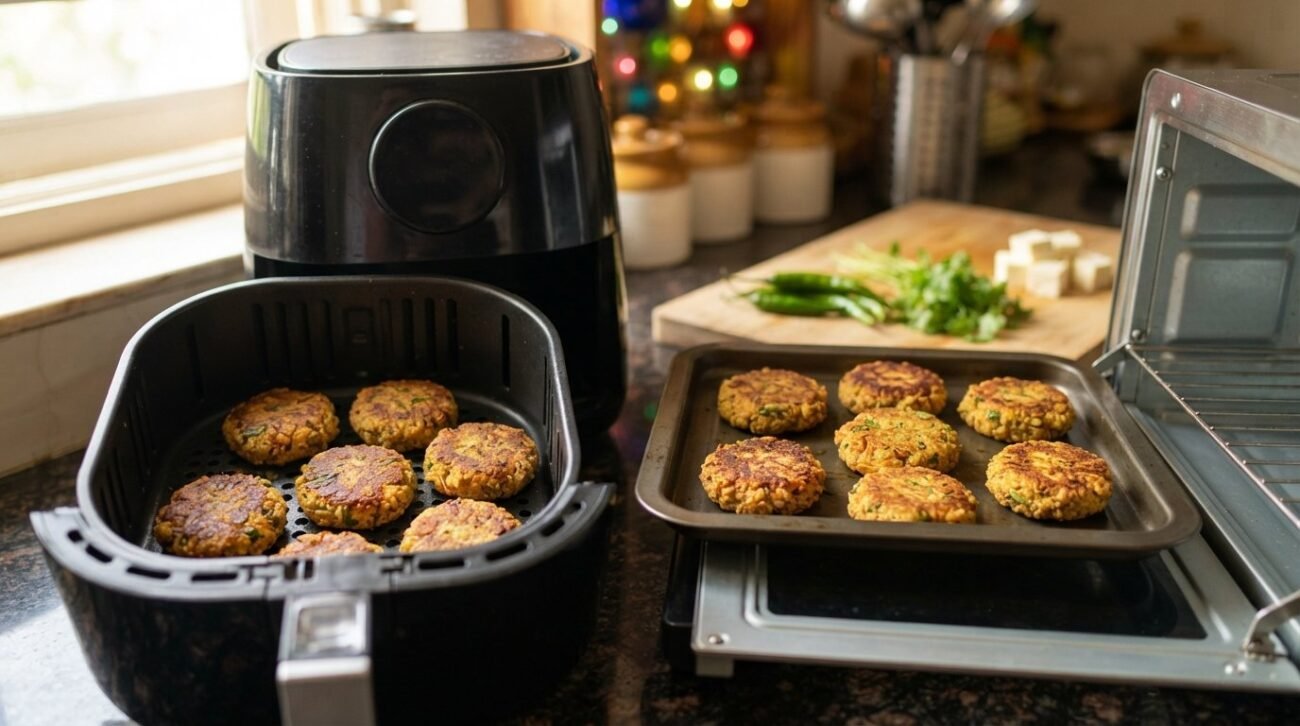
The faster cooker isn’t automatically the cheaper buy. Whether air fryer recipes are cheaper and easier than oven recipes in India once you factor in appliance costs depends on what you cook, how much you make at once and how often you use the appliance. For a 20-minute full-power cook, a 1,500-watt air fryer uses 0.5 units of electricity, while a 1,600-watt OTG uses 0.53 units. An air fryer preheats in about 3 minutes; an oven takes 10-15 minutes.
Air fryer recipes can be quicker and simpler for small batches, while an oven or OTG gives you room to cook more at once. To decide whether air fryer recipes are cheaper and easier than oven recipes in India, compare appliance prices, preheating, oil use, accessories and running costs against the way you actually cook. Batch size matters: a lower cost for one small cook may not mean better value for your household.
Key Takeaways
- Compare appliance purchase cost with how often you’ll use it, your household size and the portions you usually cook.
- Factor in capacity, batch size, preheating and cooking time when estimating electricity use; a smaller appliance isn’t automatically cheaper for every meal.
- Choose a compact air fryer for small daily portions, a larger basket or oven for family meals, and commercial-capacity equipment for food preparation businesses.
- Include oil, useful accessories, warranty coverage and after-sales support in your calculation, and leave room around basket foods for air to circulate.
- Use the recipe examples and Chef Meghna’s tips to adapt vegetarian ingredients and troubleshoot uneven cooking.
- Explore the Air Fryer Recipe Collection for more ideas that fit your everyday cooking style.
Is an Air Fryer Actually Cheaper to Run Than an Oven?
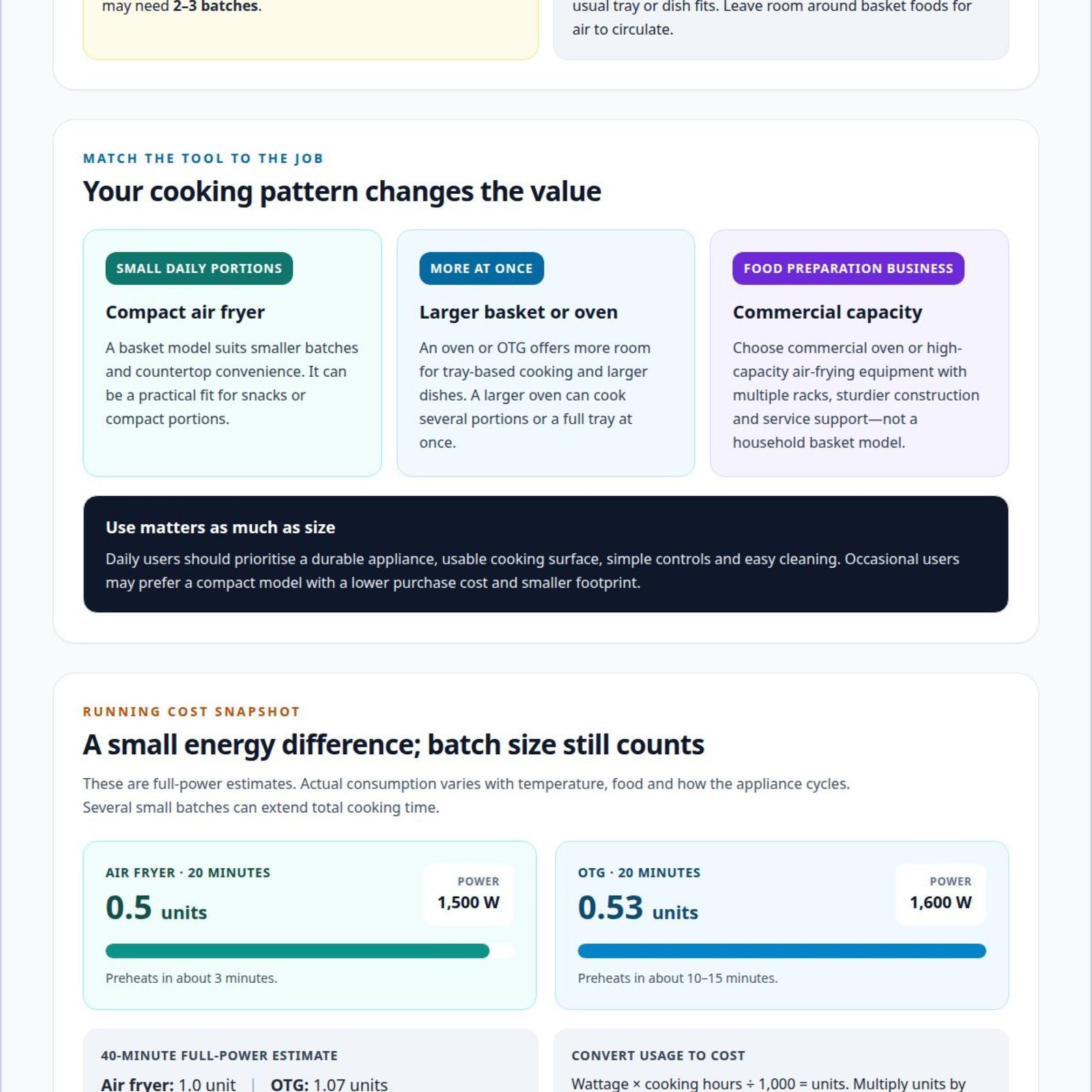
For a 20-minute cook, a 1,500-watt air fryer uses 0.5 units; a 1,600-watt OTG uses 0.53. Your electricity rate and cooking method shape the bill.
Electricity Cost Calculations
Estimate electricity cost by multiplying appliance wattage by cooking hours, then dividing by 1,000. Multiply the resulting units by your rate per unit. A kettle-and-hob routine needs separate estimates: kettle electricity, then the energy used to finish cooking on an electric or gas hob.
Air Fryer Monthly Running Costs
That estimate assumes the appliance runs at full power throughout, but actual consumption varies with the temperature, food and how the appliance cycles. Several small batches can extend total cooking time, so count every session, not just the first basket.
Per-Session Appliance Costs
These are full-power estimates, not fixed costs for a recipe. If you use a kettle to assist cooking, include its electricity use and the hob’s additional energy. Gas cooking will not appear on your electricity bill.
Air Fryer and Electric Oven Costs
A 1,500-watt air fryer running for 40 minutes uses 1.0 unit; a 1,600-watt OTG uses 1.07 units. A larger oven may run longer or heat more space, while an air fryer may need repeated batches. Boiling water in a kettle before using an electric hob adds a separate electricity load; with a gas hob, it adds electricity for the kettle and gas for cooking.
| Option | Electricity measure | Cost comparison |
|---|---|---|
| Air fryer, 20 minutes | 0.5 units | Lower due to rapid heat circulation |
| OTG, 20 minutes | 0.53 units | Slightly higher for preheating space |
| Kettle and electric hob | Two electricity uses | Count kettle and hob separately |
| Kettle and gas hob | Kettle electricity plus gas | Electricity bill excludes gas |
Compare total cooking time, number of batches and energy source, not wattage alone at Meghna’s Food Magic.
Appliance purchase prices and entry costs
These price ranges cover different products, so compare capacity and intended use rather than choosing the lowest price. The key question is whether air fryer recipes are cheaper and easier than oven recipes in India after factoring in the appliance purchase.
The listed basket models span 3.2-7.2 litres; classic OTGs span 16-50 litres. A bigger cavity can handle larger dishes, while basket space determines how much food fits in each batch.
For Indian snacks, an air fryer suits compact portions of samosas or crisp vegetables; an oven or OTG offers more room for tray-based cooking and larger dishes. A 3-4-litre basket is suited to a small portion or two, while a 6-8-litre basket can cook a group batch. A 4-litre model fits only 4-5 samosas, so a family of four or five may need 2-3 batches. That’s why the question of whether air fryer recipes are cheaper and easier than oven recipes in India depends on portion size as well as appliance cost.
Maintenance and replacement-part costs vary by appliance, the part that needs replacing and warranty coverage. Compare warranty terms and possible repair needs before buying: the purchase price alone does not show the long-term cost.
For setup, leave a few inches behind a compact air fryer so its rear vents can release heat. After cooking, remove food residue from the basket or oven tray, and keep the heating area clear. A basket model suits smaller batches and countertop convenience; an OTG is a better fit when capacity matters more than counter space.
Choosing capacity for family size and usage
Capacity should match both household size and the way you cook. For one or two people, a 3-4-litre air fryer or a 16-25-litre OTG is suitable for small portions, reheating and occasional snacks. A family of three or four will usually find a 5-6-litre air fryer or a 25-40-litre OTG more practical for everyday vegetarian meals. For five or more people, choose a 6-8-litre air fryer, a dual-basket model or a 40-60-litre oven so you can reduce repeated batches.
For daily cooking, prioritise a durable appliance with a usable cooking surface, simple controls and easy cleaning. Occasional users may prefer a compact model with a lower purchase cost and smaller footprint. For commercial food preparation, choose a commercial oven or high-capacity air-frying equipment with multiple racks, sturdier construction and service support rather than relying on a household basket model.
Remember that advertised litres do not equal usable cooking space. Check basket dimensions, rack positions and the size of your usual tray or dish. A larger oven can cook several portions or a full tray at once, while a smaller air fryer may require multiple rounds even when its listed capacity appears sufficient.
Indian brands to compare
Prominent brands available in India include Philips, Havells, Bajaj, Wonderchef, Agaro, Morphy Richards, Usha and Borosil. Their models differ considerably, so compare the exact capacity, controls, accessories, warranty and local service coverage rather than choosing by brand name alone.
| Brand | Advantages | Disadvantages | Value and after-sales considerations |
|---|---|---|---|
| Philips | Strong recognition, broad air-fryer range and straightforward everyday operation. | Comparable models can cost more, and smaller baskets may not suit large families. | Good value for buyers prioritising established support; check warranty terms and service availability in your city. |
| Havells | Modern designs, useful preset functions and options across household capacities. | Features and usable space vary widely between models. | Compare included accessories and local service access before paying for extra programmes. |
| Bajaj | Familiar Indian appliance brand with accessible household options. | Entry-level models may offer fewer controls and smaller cooking areas. | Often worth considering for budget-focused buyers; confirm spare-part and authorised-service availability. |
| Wonderchef | Broad kitchen-appliance selection and models aimed at home cooks. | Prices and feature sets vary between product lines. | Assess capacity against price and check the warranty process, service response and replacement-part terms. |
| Agaro | Many feature-rich models and larger-capacity choices at competitive prices. | More features can mean a steeper learning curve and different service experiences by location. | Can offer strong value when capacity and presets matter; verify local support before purchase. |
| Morphy Richards, Usha and Borosil | Established kitchen-appliance options with oven, OTG or air-fryer models in selected ranges. | Availability, capacity and feature depth differ by model and retailer. | Compare like-for-like specifications, warranty coverage and authorised service access for your area. |
Air fryer and oven preheating times
An air fryer preheats in about 3 minutes, while an oven takes 10-15 minutes. That difference matters most for short cooking sessions and quick reheating, because preheating adds time before food goes in.
For a 20-minute recipe, allow about 23 minutes with air-fryer preheating, compared with 30-35 minutes using an oven that needs preheating. These totals combine the stated heating times with the cooking example; actual recipes may call for different preparation.
Air-fryer cooking times for Indian favourites give a useful starting point: samosas take 12-18 minutes, while vegetable tikka or stuffed peppers may take about 15-25 minutes. Many Indian air-fryer recipes use 180°C-200°C for 10-20 minutes. Oven timing depends on the recipe and appliance, so don’t assume the same temperature or duration transfers unchanged.
For reheating a small portion, an air fryer’s shorter preheat can make the process more straightforward. A larger oven may suit a full tray or several portions, though its longer preheat adds time before cooking starts. With either appliance, arrange food as the recipe directs and check for doneness rather than relying on the clock alone.
Think in complete cooking sessions. For a 20-minute bake, compare the 3-minute air-fryer preheat with the oven’s 10-15 minutes, then add the recipe’s own cook time. If the oven is already hot from another dish, its preheating delay may not apply to the next batch. That changes the convenience comparison without changing the recipe.
Choose an air fryer when a small portion and quick start suit the meal; use an oven when a larger tray makes batch cooking practical. For samosas or vegetable tikka, treat air-fryer timings as a starting point. Oven recipes need their own temperature settings and signs of doneness.
Air fryer oil and accessory costs
Most air fryer recipes need a teaspoon of oil or less, while deep frying uses substantially more. A comparison estimates air fryers use 70-90% less oil than deep frying. For a family deep-frying 2-3 times per week, the estimate is about 2 litres monthly.
For vegetables, lightly coat the pieces with oil instead of pouring oil into the basket. Frozen snacks often already contain oil, so extra coating may not be needed; follow the recipe. In either case, leave space around each piece. Crowding restricts airflow, which can lead to uneven browning and another cooking batch.
Accessory costs depend on the recipes you plan to make. Food sits directly in an air-fryer basket, while an oven recipe may need a suitable tray or rack. Before buying extras, consider the dishes you cook and whether the appliance includes a usable cooking surface. Do not count optional accessories as necessary additions to the purchase price.
Keep accessories practical: an oven tray that fits can hold a larger batch, while an air-fryer basket suits smaller portions with space between pieces. Arrange frozen samosas or vegetables in a single layer without crowding. These simple steps support even cooking without extra equipment. Oil savings matter most if you regularly deep-fry; occasional users may care more about basket space and easy cleanup.
Comparing air fryer and oven running costs
Running costs depend on cooking time, portion size and batch count, not wattage alone. To judge whether air fryer recipes are cheaper and easier than oven recipes in India after appliance costs, compare the full cooking session and factor in the appliance’s purchase price.
Recipe Costs with Ingredients and Electricity
For the same recipe and ingredient quantities, food costs stay comparable; electricity use changes with the appliance and cooking time. A 40-minute session uses 1.0 unit in a 1,500-watt air fryer and 1.07 units in a 1,600-watt OTG. Extra air-fryer batches add time and electricity.
For samosas or vegetable tikka, compare equal portions. An oven tray may fit more food at once, while a crowded air-fryer basket can mean cooking in separate batches.
Purchase-Cost Recovery Through Meals
There is no fixed number of meals at which an air fryer’s higher purchase price pays for itself. Divide the price difference between appliances by the saving per comparable meal, including electricity and oil. This estimates how many meals it would take to recover the difference. If each air-fryer meal costs as much or more to make, running-cost savings will not offset the higher upfront cost.
Whether air fryer recipes are cheaper and easier than oven recipes in India once appliance costs are included depends on the savings per meal and how often you cook.
For reheating a small portion, a microwave may be more practical than either appliance. For a larger meal, compare the oven’s full tray with every air-fryer batch needed.
A compact air fryer can suit frequent small-batch cooking, but its running-cost advantage depends on avoiding repeated loads. Compare the same recipe, portion size and cooking result. This helps you decide whether the extra purchase cost suits your kitchen, rather than assuming one appliance always costs less.
Air Fryer Recipes to Try
These small-batch ideas show how an air fryer handles crisp snacks and warmly spiced vegetables. Leave space between pieces so air can circulate, and arrange ingredients in a single layer where possible.
Air-Fried Samosas
Ingredients: 4 frozen samosas and 1 teaspoon oil.
Method: Preheat the air fryer, then brush or spray the samosas lightly with oil. Place them in the basket with space between each piece. Cook at 180°C-200°C for 12-18 minutes, turning halfway through. The open gaps help hot air reach the sides; avoid stacking, which can make browning uneven. Serve hot with chutney.
Air-Fried Vegetable Tikka
Ingredients: 500 g mixed vegetables such as cauliflower, bell peppers and onions, 60 g plain yoghurt, 1 teaspoon ginger paste, 1 teaspoon garlic paste, 1 teaspoon lemon juice, 1 teaspoon tandoori masala, ¼ teaspoon turmeric, ½ teaspoon salt and 1 teaspoon oil.
Method: Mix yoghurt, ginger, garlic, lemon juice, masala, turmeric and salt. Coat the vegetables evenly, then marinate them in the refrigerator. Arrange the pieces in one basket layer, leaving space around each piece. Brush with oil and cook at 180°C for 15-25 minutes, turning halfway. Check that the vegetables are tender and browned before serving.
For either recipe, cook in batches if the basket is crowded. A single, roomy layer lets heat circulate, while a packed basket may need more attention and turning. To compare with an oven, use the same ingredient quantities, then note cooking time and batch size. Frozen samosas make a quick snack; marinated vegetables make a colourful meal or side dish. Treat the timings as a starting point because piece size and appliance performance affect browning. Serve with chutney, salad or other vegetables for a satisfying plate.
Chef Meghna’s Notes
A good air-fryer result starts with matching the food to the appliance. Samosas and evenly sized vegetable pieces brown well when hot air can circulate around them. For a broad tray of vegetables or several portions, an oven may make arranging the food easier. Choose according to the texture you want and the amount you are cooking.
For a simple substitution, use thick yoghurt in a vegetable tikka marinade when you want it to cling to the pieces. If the mixture looks runny, add the yoghurt gradually and coat each piece lightly. Excess marinade can drip into the basket; a thin coating helps the spices stick without pooling underneath.
- Uneven browning: Arrange samosas or vegetables in one layer, leave gaps, and turn pieces midway.
- Soft frozen snacks: Avoid stacking them; crowding restricts airflow and can leave surfaces less crisp.
- Unevenly cooked vegetables: Cut pieces evenly and check the firmest piece before serving, rather than extending cooking automatically.
For an oven recipe adapted to an air fryer, treat its temperature and timing as a starting point, not a direct conversion. Air fryer recipes commonly use 180°C-200°C, but thickness, moisture and basket loading affect results. Look for browned edges and check the centre of the vegetables for doneness.
Use accessories that fit the appliance and do not block airflow. A crowded basket may require separate batches; an oven tray can spread the same ingredients out. For easier cleanup, let the basket cool, then remove crumbs and residue according to the appliance’s care instructions.
For a fair comparison, keep ingredient quantities and portion size consistent when making the same dish in an air fryer and an oven. Note the cooking time, number of batches and final texture. This makes it easier to refine samosas, vegetables or other vegetarian dishes for the appliance you use most.
Meghna’s Food Magic: Air Fryer Recipe Collection
Meghna’s Food Magic is a natural next step if you’ve chosen an air fryer and want recipes suited to it. The Air Fryer Recipe Collection helps you move from appliance comparisons to everyday cooking, with ideas for snacks and meals. Its air-fryer recipe videos can also help you explore different dishes and cooking approaches.
Meghna’s Food Magic offers a free digital recipe database with ideas to explore based on what you feel like cooking. As you browse, consider your usual portions and ingredients. A smaller basket suits compact batches, while recipes needing more space may work better across separate rounds.
Planning a satisfying meal? Explore the High Protein Recipes collection alongside your air-fryer cooking. Check each recipe’s ingredients and method, then choose an idea that suits your appetite and the amount your appliance can comfortably hold.
Explore the air-fryer collection for dishes that suit your menu and appliance. Consider what you feel like cooking, then check the ingredients and method before choosing a recipe. The collection includes ideas for snacks and meals, giving you options to browse for different occasions and portions.
Use these recipe collections after weighing purchase cost, cooking time, oil and batch size. Choose a dish that matches your appliance capacity, then follow its method and ingredient quantities. If you’d like to get in touch, contact Meghna’s Food Magic.
Frequently Asked Questions
How Much Does an Air Fryer Cost to Run?
There is no single running cost for every Indian kitchen. For a household estimate, check the electricity tariff on your bill and measure a complete cooking session with a plug-in energy monitor. Record consumption for a dish you make regularly, then repeat the measurement under the same conditions. This gives you an estimate based on your appliance and cooking habits, rather than a broad market assumption.
What is the price of a 4-6 litre air fryer in India in 2026?
A 4-6-litre air fryer doesn’t have one fixed price across India in 2026. The amount varies by model and retailer, so compare the final listed price for the specific capacity you need. Before choosing, check the product’s stated basket size and included accessories against your cooking routine. A model that fits your regular portions may offer better practical value than paying for capacity you rarely use.
What is the price of a comparable convection oven or OTG in India?
There is no single price for every comparable oven or OTG in India. The final cost depends on appliance type, capacity and model. First decide whether you need an OTG or a convection microwave, as they are different appliance categories. Then compare models with similar cooking space and intended use, rather than treating a compact countertop unit and a larger oven as equivalent purchases.
How much electricity does an air fryer use per meal compared with an oven in India?
Electricity use per meal depends on the appliance and the full cooking session. For a practical comparison, measure each appliance from the start of cooking until the food is ready, using the same recipe and quantity. Include any extra rounds needed to finish the meal. You can then compare your own energy readings instead of relying on a general estimate that may not match your portions.
Are air fryers more energy efficient than ovens according to reliable tests or manufacturer specifications?
A test may show an energy advantage for a particular dish and appliance pair, but the result will not necessarily apply to every recipe. Look for measurements that compare the same quantity of food at the same level of doneness and include the full cooking cycle. Manufacturer specifications describe the appliance, but do not by themselves show how much energy your meal will use. A consistent side-by-side test at home can reveal which option better fits your cooking routine.
Disclaimer
This is a recipe food blog page and not nutrition or doctor and hence do not claim to cure any illness. If you have specific health issues please consult a qualified doctor or certified nutritionist.
I do consult experts, research Internet and at times seek help from Gemini to collect relevant information to put together some of these blogs.

