
How to Calculate Calories in Food: A Step-by-Step Guide
What if tracking your nutrition felt less like a math exam and more like a secret ingredient for your success? Most of us have felt that familiar sting of frustration when trying to figure out how to calculate calories in food, only to be met with conflicting online data or confusing rules about raw versus cooked weights. It’s exhausting to feel like you have to choose between your fitness goals and the vibrant, flavorful meals you actually love to eat.
I completely understand the worry that a splash of oil or a sprinkle of masala might throw your hard work off balance. You shouldn’t have to sacrifice the soul of your cooking just to see results on the scale. In this guide, I’m going to help you master the art of calorie counting with expert tips tailored specifically for the home cook. We’ll dive into the 4-9-4 rule, solve the mystery of “hidden” calories, and explore how to hit your fitness targets while still indulging in your favorite high-protein and millet-based recipes.
Key Takeaways
- Learn the simple science of how to calculate calories in food using the 4-9-4 rule to turn your kitchen into a space of health and empowerment.
- Discover the “Total Recipe Method” to accurately track complex home-cooked meals, including often-missed additions like tadka oils and masalas.
- Understand the vital difference between empty calories and nutrient-dense fuel to ensure your body feels satisfied and energized.
- Identify hidden calorie traps like liquid calories and “taste test” bites that can subtly impact your fitness progress.
- Apply Chef Meghna’s professional tips for bulk prepping and eating out to maintain your progress without losing the joy of eating.
Understanding the Energy on Your Plate: What Are Calories?
Think of your plate as a vibrant source of power rather than a list of restrictions. A calorie isn’t a scary number or a hidden enemy; it’s simply a unit of energy that fuels your every move, from a morning yoga session to a busy day in the kitchen. Understanding the science of food energy helps us see our meals as the beautiful fuel they truly are. When you’re learning how to calculate calories in food, you’re really learning how to nourish your body with intention and care.
At Meghna’s Food Magic, my philosophy is simple: while the numbers matter for your fitness goals, the flavor is absolutely non-negotiable. I want you to feel empowered, not restricted. There’s a world of difference between “empty calories” from highly processed snacks that leave you hungry and tired, and “nutrient-dense calories” from whole grains and fresh produce. Choosing nutrient-dense options means you’re getting vitamins, minerals, and fiber along with that energy, which helps you glow from the inside out.
Why Calorie Awareness Matters for Weight Loss
To lose weight effectively, you generally need to maintain a caloric deficit. This means consuming slightly less energy than your body uses throughout the day. On the flip side, a caloric surplus is what we aim for when building muscle. Tracking your intake is a brilliant way to uncover “invisible” eating habits. You might not realize how that extra spoonful of sugar in your third cup of chai or the handful of namkeen you munch on while preparing dinner adds up. Learning how to calculate calories in food turns these mindless moments into mindful, celebratory choices that keep you on track.
The Role of Nutrients Beyond the Numbers
Have you ever wondered why 100 calories of millets feel so much more satisfying than 100 calories of white sugar? It’s because of how your body processes different types of fuel. Fiber-rich foods provide incredible satiety, which is that wonderful feeling of being full and satisfied. This is especially vital if you’re managing PCOS or working toward specific fitness milestones. By understanding the “why” behind your ingredients, you can prioritize high-volume, high-nutrition foods. This ensures every bite serves a purpose, helping you maintain a healthy balance without ever feeling like you’re missing out on the joy of a delicious, home-cooked meal.
The 4-9-4 Rule: How to Calculate Calories from Macronutrients
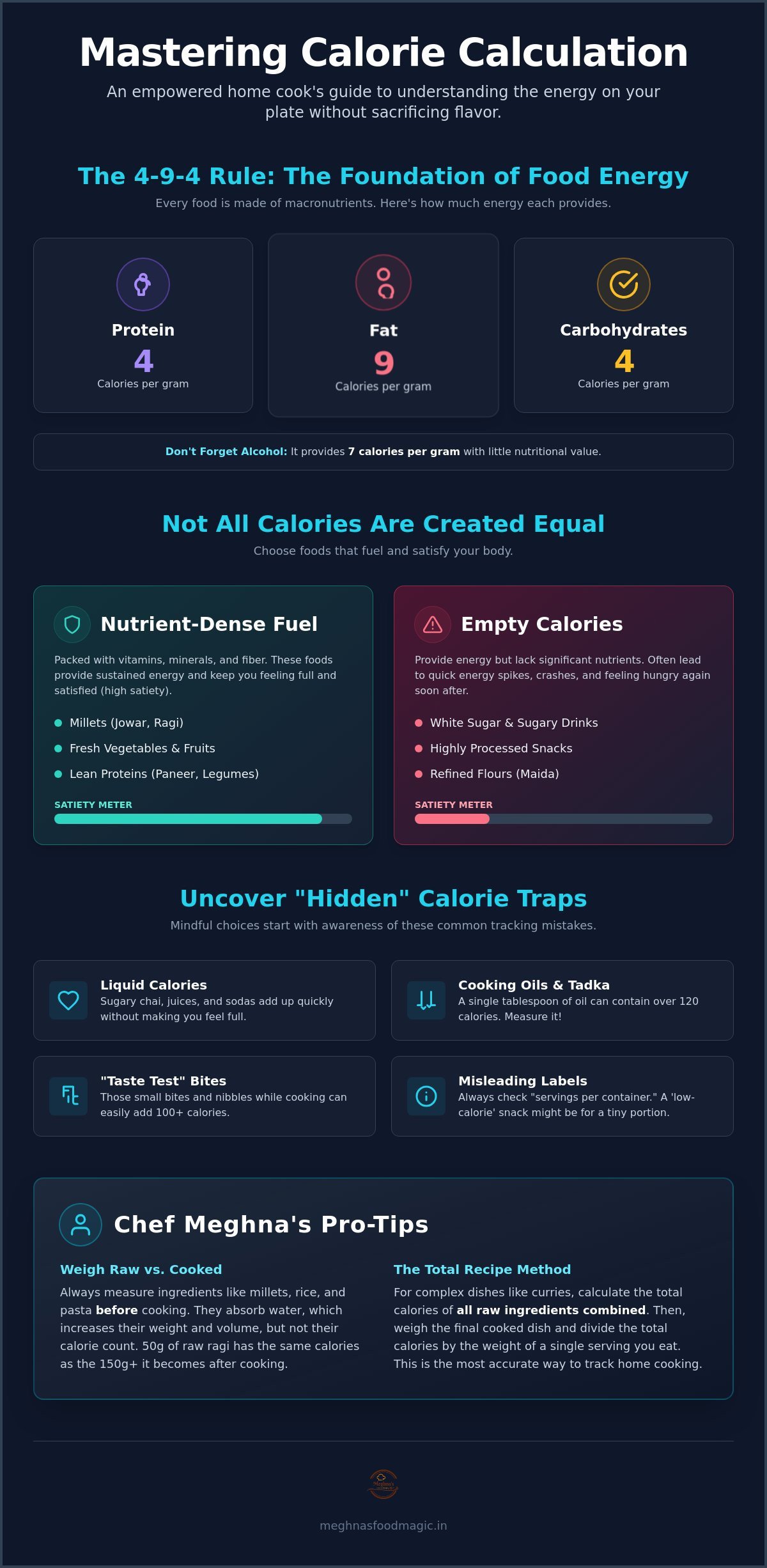
Every delicious meal you create is a symphony of three main building blocks: carbohydrates, proteins, and fats. To truly master how to calculate calories in food, you need to understand the “4-9-4” formula. This is the gold standard for decoding the energy in your ingredients. Both proteins and carbohydrates provide 4 calories for every gram you consume. Fats are more energy-dense, offering 9 calories per gram. While they add incredible richness and satiety to a dish, knowing their caloric weight helps you use them with intention.
Let’s look at a quick example. Imagine you have a high-protein snack containing 15 grams of protein, 10 grams of carbohydrates, and 5 grams of fat. You would calculate the energy like this:
- Protein: 15g x 4 = 60 calories
- Carbohydrates: 10g x 4 = 40 calories
- Fats: 5g x 9 = 45 calories
- Total: 145 calories
It is also helpful to remember the “hidden” fourth macro: alcohol. It carries 7 calories per gram. These liquid calories don’t offer much in the way of nutrition, so being aware of them is vital for maintaining your balance. Understanding these weight-loss basics is the first step toward total food freedom.
Reading Nutrition Labels Like a Pro
Labels can be tricky. Often, a package will list values “per 100g” rather than for the entire container. If a 400g pack of paneer says it has 250 calories per 100g, the whole block actually contains 1,000 calories. Always check the “Servings per Container” to avoid underestimating your intake. You should also watch out for hidden sugars disguised as maltodextrin, rice syrup, or dextrose. These can sneak into “healthy” packaged foods and spike the calorie count without you realizing it.
Calculating Calories for Raw vs. Cooked Ingredients
I always recommend weighing your ingredients raw whenever possible. Water is the great weight changer in the kitchen. When you cook grains like Jowar, Bajra, or rice, they soak up water and expand. While the weight on the scale goes up, the calorie count stays exactly the same as the raw portion you started with. As a quick rule of thumb, 50g of raw millet will yield a much larger volume once cooked, but it still represents the same energy value. If you want to see these grains in action, you can explore my favorite ways to prep them on my YouTube channel for more inspiration.
Calculating Calories for Complex Home-Cooked Recipes
Home cooking is a beautiful, soulful process, but it can feel like a bit of a puzzle when you’re trying to figure out how to calculate calories in food for a multi-ingredient curry or a hearty dal. The secret to accuracy lies in the “Total Recipe Method.” Instead of trying to guess the energy in a single bowl at the end, you sum up every raw ingredient before it ever hits the pan. Use the USDA’s macronutrient calorie values to find the energy for each component, from the base grain to the smallest pinch of seeds, then add them all together. Once your masterpiece is ready, simply divide that grand total by the number of servings you’ve prepared. To make your life even easier, I recommend using the same bowl or katori every time. This simple consistency removes the guesswork from your daily tracking and lets you focus entirely on the joy of the meal.
The Millet Masterclass: Tracking Ancient Grains
When we dive into the world of traditional grains like Ragi and Bajra, the magic begins long before the stove is lit. I always emphasize specific soaking times for these millets, usually between 4 to 8 hours depending on the grain. This isn’t just about achieving a softer texture; soaking breaks down phytic acid, which significantly improves digestion and helps your body absorb all those wonderful nutrients. While a mixed-millet roti might have a similar calorie count to a standard wheat roti, the fiber content and metabolic benefits are vastly superior. If you’re looking for creative ways to integrate these powerhouses into your routine, my 30+ Millet Recipes playlist is a fantastic resource for low-calorie inspiration that never skimps on the “wow” factor.
Managing ‘The Tadka Factor’ in Indian Cooking
We often overlook what I call the “Tadka Factor,” yet it’s where many hidden calories reside in an otherwise healthy meal. Just one tablespoon of oil or ghee adds nearly 120 calories to your dish. You don’t have to give up that aromatic tempering that defines our cuisine, but you can definitely be more intentional about it. I love using high-quality non-stick pans or even an air fryer to achieve that perfect crunch and flavor with just a fraction of the fat. By reducing the oil while keeping the spices bold and vibrant, you maintain that authentic “Food Magic” taste without the heavy caloric load. This shift is a total game-changer for anyone learning how to calculate calories in food while keeping their kitchen a place of celebration and health.
Avoiding Common Tracking Mistakes and ‘Hidden’ Calories
Even when you’ve mastered the basics of how to calculate calories in food, small oversights can quietly stall your progress. One of the most common pitfalls is what I call the “Taste Test Trap.” In a busy kitchen, it’s so easy to take a spoonful of dal here or a bite of roti there to check the seasoning. While these moments seem insignificant, they can easily add 100 to 200 unrecorded calories to your day. This is a primary reason why many people underestimate their actual intake by 20% to 40% according to general nutritional studies.
Liquid calories are another area where precision is key. Your morning chai or coffee might look innocent; however, once you add full-fat milk and sugar, the numbers climb quickly. Similarly, fruit juices, even when freshly squeezed, lack the fiber of whole fruit and can be surprisingly calorie-dense. Don’t forget your condiments either. A vibrant green chutney is usually a safe bet, but commercial sauces or “healthy” dips can be sugar bombs in disguise. Eyeballing these portions is risky. Research shows most of us underestimate volume by 20% to 30% when we don’t measure.
The Truth About ‘Healthy’ Substitutions
Many home cooks switch to jaggery thinking it’s a calorie-free alternative to white sugar. While jaggery offers more minerals, the calorie count is nearly identical. If you’re following my Weight Loss recipes, remember that even nutrient-dense additions like nuts and seeds need to be tracked. A handful of walnuts or sunflower seeds adds wonderful texture and healthy fats, but they are energy-dense. For those with a sweet tooth, I love using my “Cake Therapy” techniques to swap heavy fats for fruit purees or yogurt. This allows you to enjoy a treat without the heavy caloric burden while maintaining the joy of the experience.
Chef Meghna’s Rationale for Precision
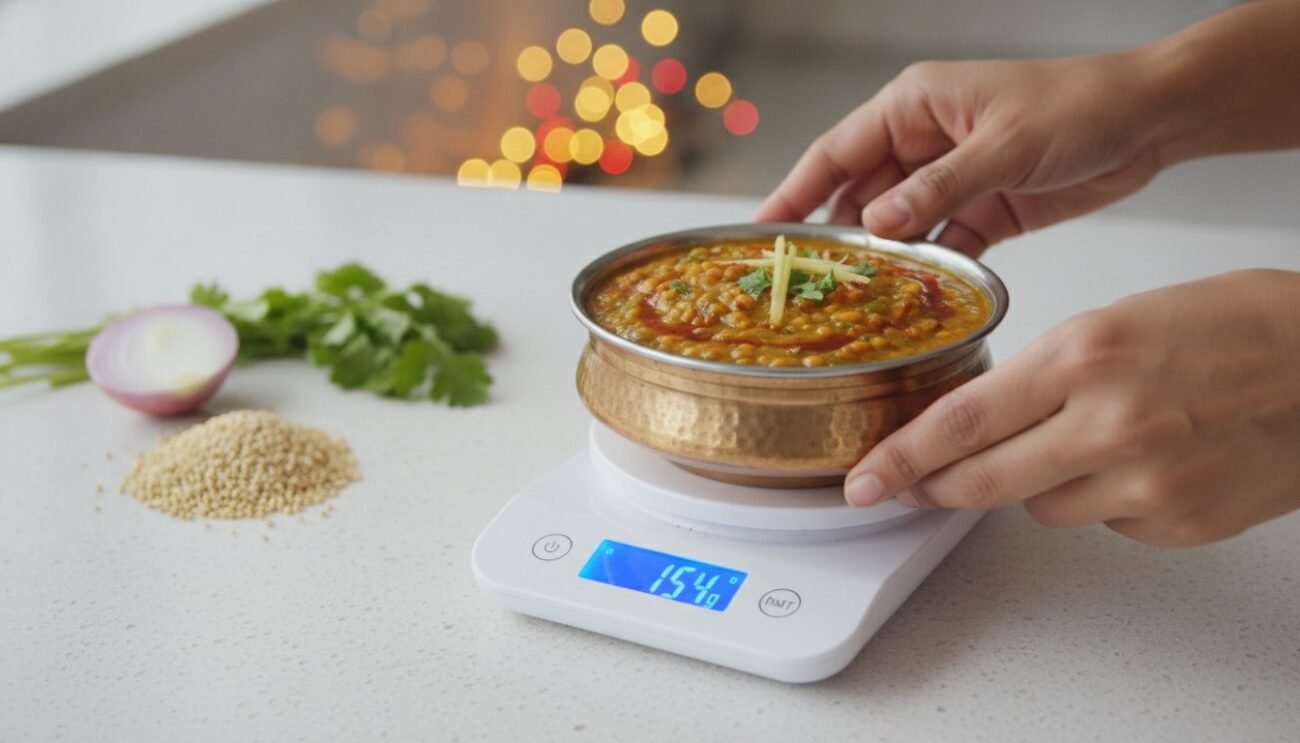
I’m a firm believer in using a kitchen scale for high-calorie items like dairy and fats. When you’re preparing my favorite Paneer recipes, a 50-gram difference in the cheese can significantly shift your daily totals. Using a scale isn’t about being restrictive; it’s about being informed. There is a profound psychological benefit to knowing exactly what’s in your food. It removes the anxiety of the unknown and replaces it with confidence. When you know the numbers, you can eat with total freedom and zero guilt. This transparency is the ultimate tool for long-term fitness success.
Chef Meghna’s Notes: Mastering Nutrition Without Losing the Joy
Mastering how to calculate calories in food is a skill that should eventually feel like second nature, much like knowing exactly when a masala is perfectly roasted by its aroma. One of my favorite professional secrets to simplify this process is bulk prepping staples. For instance, if you boil a large batch of Moong, calculate the total energy for the raw weight just once. Store it in portions, and you’ll have a pre-calculated, high-protein base ready for salads or tikkis all week long. This saves you from repeated math and ensures your tracking remains remarkably accurate even on your busiest days.
I often get asked what to do when eating out. It’s impossible to know the exact recipe, so don’t let it stress you out. Simply find the closest match in your tracking app and add a small “buffer” of about 150 calories to account for the extra oil or butter restaurants typically use. My goal for you is to find a balance where you can enjoy a meal with friends without feeling like you’ve “failed” a test. You can also make smart swaps in your own kitchen to keep things light. Try replacing heavy dairy creams with whisked yogurt or a light nut paste. Yogurt adds a lovely probiotic tang, while nut pastes provide healthy fats and a velvety texture that satisfies the palate without the heavy saturated fat of commercial cream.
Above all, remember that numbers are just one part of the story. Don’t let the math kill the magic; use it to empower your kitchen and your health. Knowing how to calculate calories in food gives you the freedom to experiment with bold flavors while staying completely in control of your fitness journey.
Effortless Improvement Hacks
If you want to feel satisfied while eating fewer calories, become a “volume eater.” This means filling your plate with low-calorie, high-nutrient items like leafy greens, cucumbers, and bell peppers. I swear by the “Half-Plate Rule,” where half of every meal consists of colorful vegetables. This ensures you’re getting plenty of fiber and micronutrients, which keeps your energy levels stable. For more visual guidance and meal ideas that prioritize both health and taste, you can follow my Get Fit With Meghna series on YouTube.
Your Path to Culinary Therapy
I truly believe that mindful cooking is a form of culinary therapy. When you take the time to understand what goes into your body, it becomes an act of self-care and harmony rather than a chore. As we move through 2026, let’s focus on progress over perfection. Some days will be more precise than others, and that’s perfectly okay. I’d love to see how you’re balancing your fitness goals with your favorite flavors. Please come and share your journey, your successes, and even your kitchen experiments with our community on Meghna’s Instagram. Let’s keep the magic alive in the kitchen together!
Embrace Your Journey to Mindful, Flavorful Living
You’ve unlocked the secrets to decoding your plate. From mastering the 4-9-4 rule to navigating the complexity of a home-cooked tadka, you now have the tools to make every bite count. Understanding how to calculate calories in food isn’t about being perfect; it’s about building a harmonious relationship with your meals. It turns the kitchen into a space of empowerment where you can celebrate traditional flavors while hitting your fitness goals with ease. Precision gives you the confidence to enjoy your favorite treats without any lingering guilt.
Join thousands of home cooks in our ‘Get Fit With Meghna’ community to access 1000+ specialized recipes for free. Cooking is an act of joy and self-care, and I’m here to guide you every step of the way. Don’t let the numbers overwhelm you. Use them as a guide to nourish your body and soul. I can’t wait to see the magic you create in your kitchen!
Frequently Asked Questions
Is it better to track calories or macronutrients for weight loss?
Tracking calories is the most important factor for weight loss because it manages your overall energy balance. Macronutrients, however, determine the quality of that weight loss and how satisfied you feel. While calories dictate the scale, hitting your protein and fiber targets ensures you lose fat rather than muscle and keeps your energy levels stable throughout the day.
How do I calculate calories in a dish with many different vegetables?
For a mixed vegetable stir-fry or curry, you can group non-starchy vegetables like peppers, cauliflower, and beans together using an average of 30 calories per 100 grams. If the mix includes starchy items like potatoes, sweet potatoes, or green peas, weigh those separately for better accuracy. This keeps the process fast and joyful without getting bogged down by every single piece of spinach.
Do I need to track spices and masalas in my daily calorie count?
Dry spices like turmeric, cumin, and coriander powder are so low in calories that they don’t need to be tracked individually. You should only account for masalas if they are part of a wet paste containing oil, coconut, or nuts. Focus your energy on tracking the main ingredients and cooking fats rather than the pinch of garam masala that adds flavor without the heavy caloric load.
What is the most accurate way to measure oil used for deep frying?
The best way to measure frying oil is to weigh your oil container before and after you cook. The weight lost from the container is exactly what your food absorbed during the process. Since oil carries 9 calories per gram, a 15-gram difference means your snacks have soaked up 135 calories. This is much more reliable than trying to guess how much is left in the pan.
How can I estimate calories when eating at a traditional Indian wedding?
When you’re enjoying a festive feast, use the “Plate Method” by filling half your plate with salads or dry vegetable dishes. Keep portions of rich gravies and desserts to a single serving. Because wedding food is often prepared with extra ghee, add a flat “buffer” of 250 to 300 calories to your daily log to account for those delicious hidden fats.
Why do my calculated calories differ from what a fitness app says?
Fitness apps often rely on user-submitted data which can be inaccurate or based on different regional varieties of an ingredient. When you learn how to calculate calories in food using your own raw weights and specific brands, your manual calculation will always be more precise. Apps provide a great estimate, but your kitchen scale and the 4-9-4 rule are the gold standards for accuracy.
Can I lose weight without counting every single calorie?
Yes, you can achieve weight loss by focusing on high-volume, low-calorie foods and mindful portion control. By prioritizing fiber-rich millets and filling half your plate with vegetables, you naturally create a caloric deficit without needing to track every bite. Tracking is a brilliant teacher that builds your nutritional awareness, but the ultimate goal is to eat intuitively and enjoy the magic of your food.
Disclaimer
This is a recipe food blog page and not nutrition or doctor and hence do not claim to cure any illness. If you have specific health issues please consult a qualified doctor or certified nutritionist.
I do consult experts, research Internet and at times seek help from Gemini to collect relevant information to put together some of these blogs.

