
Oven vs Microwave vs Air Fryer: How to Choose the Best
What if the secret to a perfectly crisp, guilt-free samosa or a moist, nutritious ragi cake isn’t just in your ingredients, but in the specific science of the appliance on your counter? It is completely normal to feel overwhelmed by the technical jargon of OTGs, convection modes, and rapid air technology, especially when you are trying to balance a busy lifestyle with a commitment to healthy eating. You want those delightful textures without the heavy oil, yet the fear of high electricity bills or losing nutrients during high-heat cooking often holds you back from making a decision.
I am here to help you master the culinary mechanics of these tools so you can finally understand how to choose best oven v/s microwave v/s air fryer for your unique, health-conscious Indian kitchen. By the end of this guide, you will know exactly which device delivers the best “Cake Therapy” results for your millet bakes and which one makes your meal prep truly efficient. We are going to explore the heating secrets of each appliance, ensuring you can create vibrant, soul-satisfying meals that celebrate both flavor and wellness every single day.
Key Takeaways
- Understand the fundamental science behind convection, radiation, and rapid air technology to preserve the vital nutrients in your daily staples like moong dal and sabzi.
- Gain a clear, practical framework on how to choose best oven v/s microwave v/s air fryer by balancing your kitchen’s counter space with your family’s specific health and speed requirements.
- Learn why the right choice of appliance is the secret to successful “Cake Therapy,” especially when mastering the unique textures of gluten-free millets like ragi and jowar.
- Discover the techniques for creating perfectly crispy, guilt-free Indian snacks such as roasted makhana and chivda using minimal oil for a heart-healthy lifestyle.
- Master Chef Meghna’s hybrid cooking strategies and zero-waste tips to repurpose leftovers into fresh, delicious meals while maximizing your kitchen’s overall efficiency.
The Great Kitchen Debate: Oven vs. Microwave vs. Air Fryer
The Indian kitchen is evolving faster than ever. We are moving away from heavy kadhais filled with shimmering oil and toward sleek appliances that promise health without sacrificing the “chatpata” soul of our food. Understanding how to choose best oven v/s microwave v/s air fryer isn’t just about kitchen aesthetics; it’s about mastering the science of heat to fuel your family’s wellness. In 2026, the choice is critical because we are no longer just cooking; we are engineering meals that balance busy schedules with high-protein, nutrient-dense requirements.
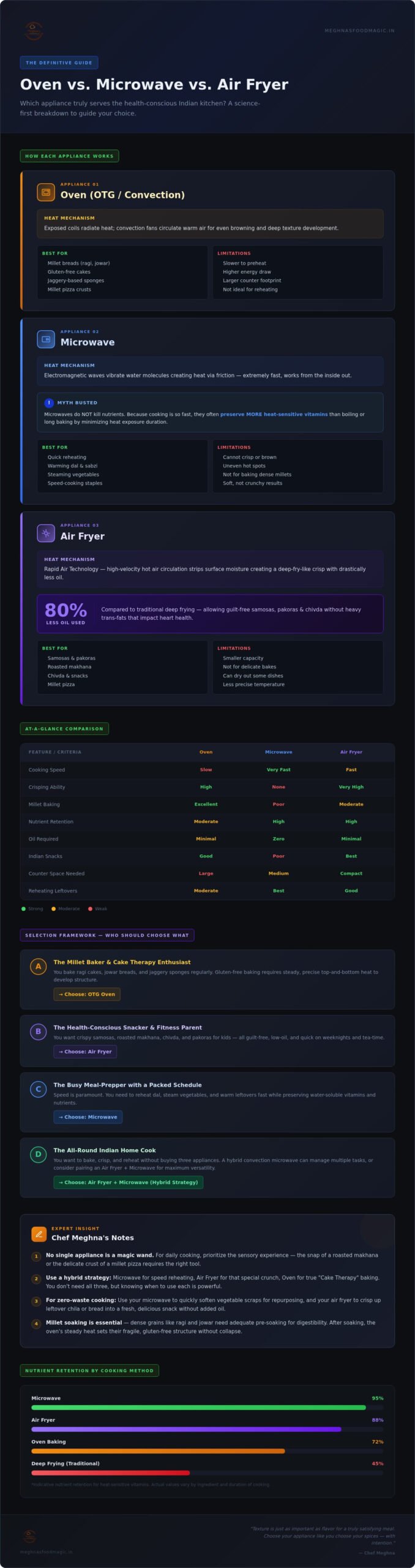
Every appliance uses a distinct language of heat. Convection ovens use heating elements and fans to circulate warm air, which is the gold standard for even browning and deep texture. Microwaves rely on radiation, specifically electromagnetic waves that vibrate water molecules to create friction and heat. Then there is the air fryer, which uses rapid air technology. Think of it as a convection oven on steroids; it uses high-velocity air to mimic the effects of deep-frying with up to 80 percent less oil. This shift is transformative for the modern Indian pantry, allowing us to enjoy samosas and pakoras without the heavy trans-fats that traditionally impact heart health and weight management.
How you apply this heat also affects the glycemic index (GI) and nutrient retention of your meals. High-heat deep frying can degrade sensitive vitamins and add unnecessary fats that spike blood sugar. Conversely, the controlled environment of an oven or the efficiency of an air fryer helps maintain the integrity of complex carbohydrates found in our beloved lentils and grains. By choosing the right tool, you ensure that your high-protein vegetarian meals remain as nutritious as they are delicious.
What is an Oven (OTG vs. Convection)?
An OTG (Oven Toaster Griller) is a purist’s dream. It uses exposed coils to radiate heat, making it the perfect partner for slow-baking dense millet breads like ragi or jowar. These ancient grains need time and steady temperature to develop a proper crumb and digestible texture. A convection microwave, however, is a hybrid. It combines microwave speed with a fan and heating element. While convenient, it often lacks the precise “top and bottom” heat control that an OTG provides. If you are looking for true “Cake Therapy” with jaggery-based sponges, a dedicated oven is where the magic truly happens.
Chef Meghna’s Notes: The Mindset of Choice
I’ll be honest with you; no single appliance is a magic wand for every dish. While I love the speed of a microwave for quick reheating, I’ll always choose my oven or air fryer when I want that specific “crunch” that makes a meal feel special. I prioritize the sensory experience of food, such as the snap of a roasted makhana or the delicate crust of a millet pizza. Texture is just as important as flavor for a satisfying meal. If you are a visual learner, head over to my YouTube channel where I show these tools in action across hundreds of fitness-oriented recipes.
Understanding the Science: How Each Method Affects Your Food
Cooking is essentially a chemistry experiment where your kitchen appliance acts as the laboratory equipment. When you are deciding how to choose best oven v/s microwave v/s air fryer, you’re actually choosing which chemical reactions to trigger in your ingredients. Let’s talk about the “Science of Crisp.” Air fryers achieve that satisfying crunch by circulating air at high velocities, which quickly strips moisture from the surface of your food. This creates a thin, crispy layer similar to deep-frying but without the oil saturation that can make Indian snacks feel heavy and sluggish.
There is a persistent myth that microwave radiation “kills” the goodness in your moong dal or sabzi. In reality, microwaves heat the water molecules within the food. Because this method is so fast, it often preserves more heat-sensitive nutrients than boiling or long baking. Shorter microwave cooking times can actually save water-soluble vitamins by minimizing the duration of heat exposure. If you’re looking for speed, the microwave is a nutritional ally, not an enemy.
Ovens provide a steady, enveloping heat that is vital for gluten-free baking. When you’re making a Ragi or Jowar cake, the lack of gluten means the structure is fragile. An oven’s consistent temperature allows the proteins and starches to set slowly and firmly, preventing the “sink” that often happens in faster, more aggressive heating environments. This steady heat is the secret to successful “Cake Therapy” with ancient grains.
Looking at 2026 electricity rates, efficiency is a top priority for every household. Air fryers generally win the frugality race for small batches because they don’t require the long preheating times of a large oven. They concentrate heat in a compact space, cooking food up to 30 percent faster, which keeps your utility bills lean while delivering high-performance results.
The Maillard Reaction and Flavor Development
The Maillard reaction is the chemical dance between amino acids and reducing sugars that gives browned food its distinctive, savory flavor. Ovens and air fryers are masters of this reaction. This is how you achieve that coveted “tandoori” effect on paneer or corn at home. By maintaining surface dryness while keeping the interior moist, these tools develop a depth of flavor that a standard microwave simply cannot replicate. For a visual guide on getting these textures perfect, you can explore my Air Fryer Recipe Collection on YouTube.
Nutrient Preservation in Modern Cooking
Antioxidants in millets are sensitive to time; the longer you cook them, the more you lose. This is why the speed of an air fryer is often superior for nutrient density compared to traditional slow-cooking methods. To preserve Vitamin C in vegetable-loaded dishes, quick high-heat methods are better than slow simmering. The air fryer is a scientific miracle for zero-waste cooking, as its rapid air can re-energize limp vegetable scraps into crunchy, nutritious garnishes in minutes.
Chef Meghna’s Notes: The Science of Texture
When working with millets, remember that soaking is non-negotiable for digestion. The science of the appliance only works if the prep is right! If your ragi cake feels too dry, try adding a little fruit puree like apple or banana; it holds moisture better under the consistent heat of an oven. Always remember, the goal is to balance the “why” of the science with the “wow” of the flavor.
Culinary Showdown: Millets, Proteins, and Indian Staples
Traditional Indian grains like Ragi, Jowar, and Bajra are the superstars of a fitness oriented pantry, but they behave quite differently under different types of heat. When you are deciding how to choose best oven v/s microwave v/s air fryer for your specific dietary needs, you must consider the density of these ancient grains. For a moist, celebratory Ragi cake, the oven is your best friend. It provides the slow, steady heat needed for the grain to absorb moisture and expand without drying out. However, if you’re making Bajra crackers or “khakhra” style snacks, the air fryer is unbeatable. It creates a brittle, satisfying snap that mimics deep frying perfectly.
Snacking is where the air fryer truly shines in an Indian home. We all love our roasted makhana and chivda, but traditional roasting on a gas stove requires constant stirring and often uneven results. In an air fryer, the rapid air circulation ensures every single seed or grain is toasted to a uniform gold. It turns a high calorie habit into a high fiber, guilt free joy. When it comes to proteins like paneer and soya chunks, the goal is to achieve a charred exterior while keeping the heart juicy. An oven might take too long and dry them out, while a microwave can make them rubbery. The air fryer hits the sweet spot, delivering a “tandoori” finish in a fraction of the time.
Reheating is another area where your choice makes a massive difference. We’ve all experienced a soggy Moong Chilla after a minute in the microwave. While the microwave is great for warming up dal or rice, it’s the enemy of texture. If you want yesterday’s chilla to taste like it just left the tawa, a three minute stint in the air fryer will revive that crisp edge beautifully. It’s about using the right tool for the right texture, ensuring that your zero waste efforts to repurpose leftovers never feel like a compromise on flavor.
Mastering Millets: Soaking and Texture
Soaking time is non negotiable for millet based oven recipes. Because millets contain phytic acid, which can interfere with nutrient absorption, a good soak of 4 to 8 hours makes them easier to digest and significantly improves the final crumb of your Jowar sponge. If your cakes are failing and turning out dense, it’s often because the grain hasn’t been hydrated enough before meeting the dry heat of the oven. For air fried snacks, ensure the millets are completely dry after soaking to achieve that perfect, loud crunch.
Chef Meghna’s Notes: The High-Protein Hack
My secret for air frying marinated paneer without it turning rubbery is to lightly brush the pieces with oil or dahi before they go in. This creates a protective barrier that seals in the moisture. I also love using the microwave for “flash steaming” hard vegetables like broccoli or carrots for 60 seconds before tossing them into the air fryer with spices. It cuts down the total cooking time and keeps the colors vibrant. For more specific ideas on building muscle while eating delicious food, check out my Air Fryer Recipe Collection for high protein inspiration.
Selection Framework: Which Appliance Fits Your Lifestyle?
Your kitchen is the heart of your wellness journey, and the tools you place on your counter should reflect your daily rhythm. When you are deciding how to choose best oven v/s microwave v/s air fryer, it’s not just about the technical specs; it’s about how that appliance supports your unique life. For many of us, limited counter space in Indian kitchens means we have to be strategic. If you only have room for one device, consider your primary goal. Is it the lightning speed of a microwave for a busy professional life, or the health-focused “crunch” of an air fryer for a fitness-oriented household?
Budgeting for 2026 means looking at initial costs versus long-term energy efficiency. A dedicated oven is a commitment to the art of baking, providing that steady environment for jaggery-based ragi cakes that a smaller tool simply can’t match. However, the air fryer is often more “frugal” for daily snacks, as it reaches cooking temperature almost instantly. It’s a bold innovator’s tool that turns a simple sweet potato into a crispy delight without the heavy electricity bill or the long preheating time of a full-sized convection oven.
The Working Mother’s Meal Prep Strategy
Efficiency is the name of the game for working parents. I often use my microwave for 5-minute healthy tiffin prep, like steaming moong sprouts or lightly softening corn for a quick, nutritious salad. When batch-cooking millets like ragi or jowar, the microwave is actually your best friend for reheating because it keeps the grains from drying out. To embrace a zero-waste lifestyle, use your oven’s residual heat after a baking session to dry out mint stalks or vegetable peels. These can be ground into flavor-packed powders, ensuring nothing in your kitchen goes to waste.
Lifestyle Match-Up: A Quick Checklist
- The ‘Set it and Forget it’ Cook: If you want to toss in your marinated paneer and walk away to handle other chores, the Air Fryer is your champion.
- The ‘Artisan Baker’: If you find peace in the slow rise of a sourdough or a millet sponge, a dedicated Oven is non-negotiable for that perfect crumb.
- The ‘Reheat and Eat’ Professional: If your life revolves around quick warm-ups of prepped dal, rice, and sabzi, the Microwave remains your essential partner.
Chef Meghna’s Notes: The Pro-Tip for Balance
Don’t feel pressured to buy every single gadget at once. Start with the tool that solves your biggest daily pain point. If you struggle with the guilt of oily evening snacks, get the air fryer first. If you want to master “Cake Therapy” for your kids’ birthdays, prioritize the oven. My goal is to make your transition to a healthier kitchen feel like a celebration, not a chore. Remember, the best appliance is the one you actually use every day to nourish your family with joy.
Chef Meghna’s Strategy: Maximizing Flavor and Nutrition
Mastering a healthy Indian kitchen isn’t about picking a single winner. It’s about creating a culinary symphony where different tools play their parts at the right time. I frequently use a hybrid cooking approach to get the best of both worlds. For instance, I might use the microwave to quickly “flash-steam” hard vegetables like cauliflower or carrots for two minutes, ensuring they are cooked through without losing their vibrant color. Then, I move them to the air fryer for a five-minute blast of high-velocity air to achieve that gorgeous, charred tandoori finish. This method saves time and ensures you don’t over-process your ingredients, keeping the nutrients exactly where they belong: in your food.
Sustainability is a core pillar of my kitchen philosophy, and your appliances are your best allies in a zero-waste lifestyle. If you have stale Jowar rotis, don’t dream of throwing them away. Lightly brush them with a touch of oil and your favorite spices, then pop them into the air fryer to create incredibly crunchy, fiber-rich baked chips. It is a resourceful way to repurpose leftovers into a healthy tea-time snack. When managing high-protein dals, I recommend storing them in glass containers as soon as they reach room temperature. Use the microwave for a gentle reheat to maintain that creamy texture, as the oven or air fryer might dry out the lentils too much.
To truly elevate your experience, you need a few essential accessories. For your oven, high-quality silicone mats are a game-changer for “Cake Therapy,” ensuring your jaggery-based millet sponges release perfectly every time. In your air fryer, perforated parchment liners are vital. They allow the rapid air to circulate freely while keeping the basket clean, making your post-cooking cleanup effortless. Understanding how to choose best oven v/s microwave v/s air fryer becomes much easier when you see these tools as partners in your wellness journey rather than competitors.
Join our vibrant Meghna’s Food Magic community on Instagram
Sustainability in the Modern Kitchen
Energy efficiency is just as important as food efficiency. To keep your 2026 electricity bills lean, avoid the habit of preheating your oven for twenty minutes when five will often suffice for most millet bakes. For small portions of roasted makhana or nuts, always choose the air fryer over the oven. It reaches the desired temperature almost instantly, saving both time and power. These small, mindful shifts turn your kitchen into a space that is as kind to the planet as it is to your body.
Chef Meghna’s Final Notes: Success in Every Bite
When you are experimenting with vegetarian “meat” alternatives like soya malai chaap, pay close attention to internal temperatures. You want them hot enough to be safe and juicy, but not so hot that they turn tough. If you are substituting refined sugar with jaggery in your oven-baked treats, remember that jaggery browns faster. Lower your oven temperature by about ten degrees to prevent burning. I invite you to explore my Free Digital Recipe Database to find the perfect recipe for whichever tool you’ve chosen. Cooking is an act of joy and self-care, so let’s make every meal a celebration!
Transform Your Kitchen into a Wellness Sanctuary
You now have the scientific and practical knowledge to turn your kitchen into a powerhouse of nutrition and flavor. We’ve explored how air fryers revolutionize guilt-free snacking and why the steady heat of an oven is non-negotiable for mastering the delicate textures of ancient grains like ragi and jowar. By understanding the unique strengths of each tool, you can move beyond confusion and start engineering meals that truly nourish your family.
Mastering how to choose best oven v/s microwave v/s air fryer is about more than just counter space; it’s about choosing the right partner for your health journey. Whether you are flash-steaming vegetables in the microwave or achieving the perfect tandoori char in an air fryer, your commitment to wellness is now backed by expert strategy. You are ready to embrace a zero-waste, high-protein lifestyle that celebrates every bite.
Join over 1 million home cooks on YouTube to access more than 500 millet and fitness recipes along with expert-vetted “Cake Therapy” baking guides that ensure your success in the kitchen.
Every small change you make today builds a more vibrant tomorrow for you and your loved ones. I can’t wait to see the magic you create in your own kitchen. Let’s keep cooking with joy and purpose!
Frequently Asked Questions
Is an air fryer really healthier than a convection microwave for Indian cooking?
Yes, an air fryer is generally healthier for achieving “fried” textures because it uses up to 80 percent less oil than traditional methods or even some convection settings. While a convection microwave circulates air, the air fryer’s rapid air technology is specifically designed to create that crispy exterior without oil saturation. This makes it the superior choice for weight loss fitness recipes like guilt-free pakoras or samosas.
Can I bake a proper Ragi or Atta cake in an air fryer?
You can bake a ragi or atta cake in an air fryer, but it requires careful temperature management to avoid a burnt top and raw center. Because the heating element is so close to the food, the cake might turn out denser than one baked in an oven. For true “Cake Therapy” where you want a light, airy crumb for your jaggery-based bakes, a dedicated oven remains the gold standard.
Which appliance consumes more electricity: an OTG or an air fryer?
An air fryer typically consumes less electricity than an OTG for daily snacks because it eliminates the long preheating times required by larger ovens. When you are learning how to choose best oven v/s microwave v/s air fryer, consider that the air fryer’s compact space and high-velocity fan cook food up to 30 percent faster. This efficiency makes it a very frugal choice for the 2026 energy landscape.
Is it safe to use plastic containers in a microwave for reheating healthy meals?
It is best to avoid plastic containers entirely when reheating healthy meals in a microwave, even if they are labeled “microwave safe.” High heat can cause chemicals to leach into your nutritious dals or sabzis, potentially disrupting your wellness goals. Opt for tempered glass or ceramic dishes to ensure your food remains pure, safe, and celebratory.
How do I avoid making my paneer or soya chunks dry in an air fryer?
To prevent paneer or soya chunks from turning dry, always marinate them in a moisture-rich base like dahi or a light brush of oil before air frying. This creates a protective seal that locks in the juices while the exterior chars. Short, high-heat bursts are better than long cooking times, ensuring your high-protein vegetarian snacks stay succulent and satisfying.
Do I need to pre-heat an air fryer like I do with an oven?
Yes, pre-heating your air fryer for 3 to 5 minutes is a professional secret for achieving the best possible crispness. Just like an oven, a hot starting environment ensures the Maillard reaction begins immediately when your food hits the basket. This simple step is vital for making your tea-time snacks like roasted makhana or chivda perfectly crunchy every single time.
What is the best appliance for a family of four focused on weight loss?
The air fryer is often the most transformative tool for a family of four focused on weight loss because it replaces deep-frying habits. It allows you to prepare large batches of fiber-rich vegetables and roasted proteins with minimal fat. Understanding how to choose best oven v/s microwave v/s air fryer helps you realize that the air fryer simplifies healthy meal prep for a busy lifestyle.
Can I make traditional Indian fermented foods like Idli in a modern oven?
Yes, many modern ovens feature a low-temperature fermentation mode that is perfect for proofing idli or dosa batter during cold winters. This controlled environment ensures consistent results for your traditional Indian fermented foods, which are essential for gut health. It’s a wonderful example of how modern technology can support ancient wellness traditions in your creative kitchen space.
Disclaimer
This is a recipe food blog page and not nutrition or doctor and hence do not claim to cure any illness. If you have specific health issues please consult a qualified doctor or certified nutritionist.
I do consult experts, research Internet and at times seek help from Gemini to collect relevant information to put together some of these blogs.

