
Managing Diabetes: Nutritious Food and Recipe Guide
Managing Diabetes: Nutritious Food and Recipe Guide
What if managing diabetes didn’t mean saying goodbye to the Indian meals you love? If advice about food and recipes for sugar patients has left you unsure whether to choose dal, rice, roti or familiar ingredients, you’re not alone. The answer isn’t a blanket ban list. Thoughtful portions and balanced combinations can help make everyday meals more considered without taking the pleasure out of cooking.
This guide offers practical ways to plan enjoyable Indian meals, choose ingredients with care and put general nutrition principles into practice with three measured recipes. You’ll find ingredient quantities, serving yields and ideas for pairing pulses, vegetables, grains and protein. Individual needs matter: medicines, glucose patterns, preferences and health history can all shape what works for one person. A qualified healthcare professional can offer guidance tailored to you, especially before you make major changes. First, let’s make diabetes-conscious cooking feel practical, flavourful and welcome at your table.
Key Takeaways
- Learn how to think about carbohydrates and portions without assuming there’s one target that suits everyone.
- Use a practical comparison of familiar Indian meal choices to explore possible adjustments and portion reminders.
- Find ideas for food and recipes for sugar patients, including measured moong dal chilla, vegetable-paneer bowl and mixed-vegetable dal.
- Use Chef Meghna’s cooking notes to troubleshoot recipes and make thoughtful ingredient substitutions.
- Turn meal planning into a repeatable routine, and take personal food questions to your diabetes care team.
Food and recipes for sugar patients: what does diabetes-conscious eating mean?
Diabetes-conscious eating is an adaptable way to plan meals by considering ingredients, portions and how foods fit together, while allowing for a person’s preferences and care needs. It isn’t a cure, a universal prescription or a guarantee of a particular blood glucose response.
That distinction matters when looking for food and recipes for sugar patients. A recipe can offer practical cooking inspiration, but it can’t replace advice tailored to your health. Diabetes care may involve food choices alongside medicines, monitoring and other guidance from qualified healthcare professionals. A meal plan should support that care, not promise to control, reverse or treat diabetes on its own.
For a general introduction to the topic, the diabetic diet overview describes broad approaches to eating with diabetes. Use general resources as starting points for questions, rather than personal instructions: what suits one person may not suit another.
What does “sugar patient” mean in everyday food searches?
“Sugar patient” is a phrase some people use when searching for diabetes-related food ideas. In this article, we’ll use the more respectful term people with diabetes. Their needs aren’t all the same. The type of diabetes, medicines, daily routine, food preferences and individual response to meals can all affect what guidance is appropriate.
A “diabetes-friendly” label on a dish can’t promise that it will affect everyone’s blood glucose in the same way. Ingredients and serving size matter, and personal responses vary. Treat recipe labels as a prompt to check what’s in the dish, not as a clinical guarantee.
Can familiar Indian meals still fit?
Familiar dishes can often be adapted rather than automatically removed from the table. A home-cooked meal of dal, sabzi and roti, for instance, can be considered as a whole: the ingredients, portions and accompaniments all shape the meal. No single ingredient makes an entire plate suitable for every person.
Think flexible, not fearful. Depending on your preferences and professional guidance, you might adjust the portion of a grain-based dish, add vegetables or include a protein-rich accompaniment. The aim isn’t to turn every family recipe into a strict formula. It’s to make thoughtful choices that preserve familiar flavours while keeping your individual needs in view. The next step is understanding how portions and meal combinations can help guide those choices.
How meal balance, portions, and carbohydrates shape diabetes-friendly food choices
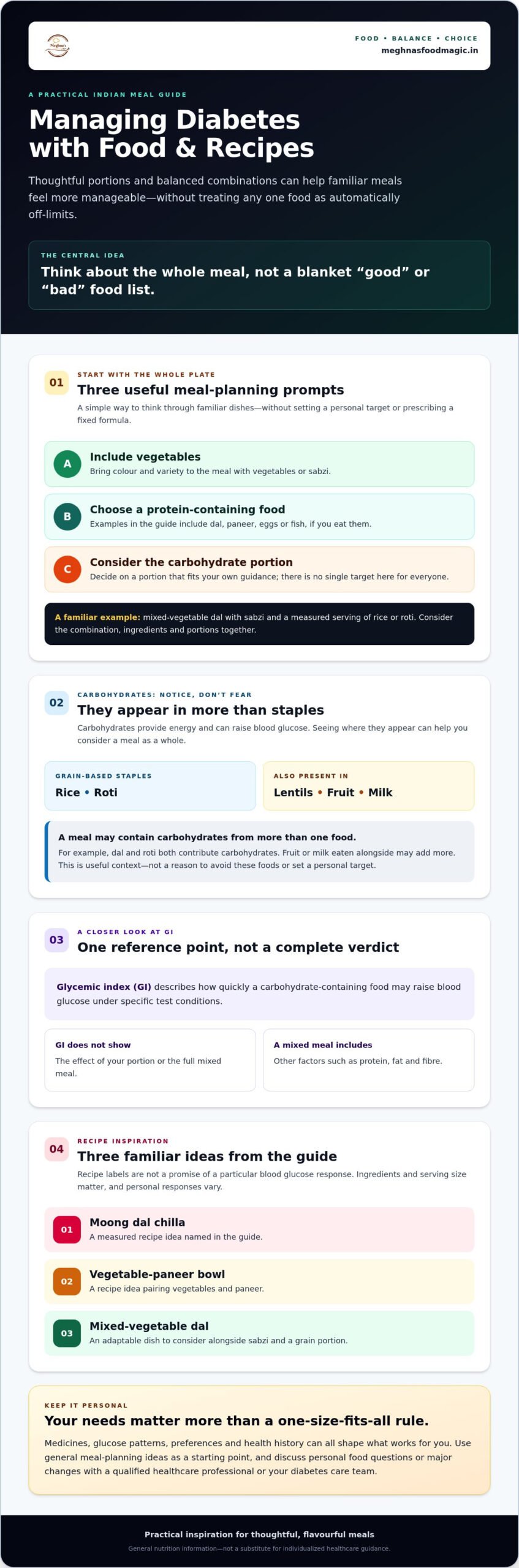
Looking at a meal as a combination, rather than labelling one ingredient “good” or “bad,” can make everyday choices easier to consider. Carbohydrates are nutrients the body uses for energy, and they can raise blood glucose. They appear in staples such as rice and roti, as well as lentils, fruit and milk. That doesn’t make these foods automatically off-limits. The amount eaten and the rest of the meal matter too.
How can readers think about carbohydrates without fear?
Start by noticing where carbohydrates appear, then consider the portion as part of the whole plate. A meal with dal and roti, for example, includes carbohydrates from both the lentils and the grain. Fruit or milk eaten alongside it may add more. That’s useful context, not a reason to avoid these foods or to set a personal target here. Individual guidance belongs with your diabetes care team.
The diabetes meal plan page from the Centers for Disease Control and Prevention introduces a plate-based way to consider portions and meal balance. Treat it as a general planning tool, not a substitute for advice tailored to your needs.
What makes a meal satisfying and adaptable?
Use a few practical prompts when planning a meal: include vegetables for colour and variety, choose a protein-containing food such as dal, paneer, eggs or fish if you eat them, and decide on a portion of a carbohydrate source that fits your guidance. A familiar plate might pair mixed-vegetable dal with sabzi and a measured serving of rice or roti. The combination gives you more to consider than any one ingredient alone.
The glycemic index (GI) describes how quickly a carbohydrate-containing food may raise blood glucose under specific test conditions, but it doesn’t show the effect of your portion or the full mixed meal, including its protein, fat and fibre. GI can be one point of reference, not a complete verdict on a dish or a person’s response.
Medication, health history and observed glucose responses can all change which choices are appropriate. If you notice a pattern after certain meals, record what you ate and discuss it with your care team rather than making medication changes yourself. Recipes can help with inspiration, but a “diabetes-friendly” label can’t guarantee an outcome.
As you explore food and recipes for sugar patients, measured ingredients can help you understand what goes into a serving. For more Indian home-cooking ideas, browse the Meghna’s Food Magic recipe channel and adapt inspiration to your own professional guidance.
Which everyday Indian food choices are easier to adapt for diabetes-conscious meals?
Indian meals offer plenty of ways to make thoughtful adjustments without turning familiar foods into a list of “allowed” and “forbidden” choices. Compare the whole preparation: what goes into the dish, how it’s cooked, what accompanies it and how much is served. Use the table as a set of prompts, not a personal prescription.
| Everyday choice | Possible adjustment | Portion reminder |
|---|---|---|
| Rice with dal | Serve with a vegetable dish, and consider how much rice and dal make up the meal. | Use the portion guidance from your clinician; rice and lentils both contribute carbohydrates. |
| Roti with sabzi | Add a protein-containing accompaniment, such as dal, paneer or egg, if it suits your eating pattern. | Consider the number and size of rotis alongside other carbohydrate sources in the meal. |
| Paneer or eggs | Cook with vegetables, herbs and spices; compare recipes for added oil, sauces and other ingredients. | Serving size and the rest of the plate still matter. |
| Vegetable sabzi | Build flavour with aromatics, spices and varied vegetables; choose a cooking method that suits the dish. | A vegetable side doesn’t cancel out portions of rice, roti or other foods. |
How can familiar staples be served thoughtfully?
Rice and roti can both be part of a meal, depending on individual guidance and the rest of the plate. For example, pair rice with dal and vegetables, or serve roti with egg bhurji and sabzi. These combinations are planning ideas, not fixed serving instructions. Your clinician can advise on portions and whether glucose monitoring is appropriate for you. Follow that advice rather than copying someone else’s plate.
Which cooking choices can add flavour without relying on blanket bans?
Layer flavour with fresh ginger, garlic, coriander, cumin, chilli, lemon or other seasonings you enjoy. Cooking technique matters too: roasting vegetables can bring out sweetness and texture, while tempering spices in a measured amount of oil can spread their aroma through a dal. Compare recipes by ingredients and serving sizes, not by the dish’s name alone. A paneer dish, for instance, can vary considerably depending on its sauce and preparation.
For more inspiration, explore vegetarian high-protein recipe ideas and consider how each recipe might fit your preferences and care guidance. Nutrition values depend on the specific ingredients, measurements and serving size, so a recipe’s name or label can’t predict an individual glucose response. These comparisons can help you approach food and recipes for sugar patients with curiosity instead of blanket rules.
Three measured diabetes-conscious recipes, plus Chef Meghna’s Notes
These measured recipes bring familiar ingredients to the table without promising a particular blood glucose response. Follow portion advice from your healthcare professional. No carbohydrate or other nutrition estimates are provided here; have any calculations reviewed before publication.
Moong dal chilla
- Split yellow moong dal: 100 g
- Water for soaking: 400 ml; additional water as needed
- Grated ginger: 1 tsp
- Ground cumin: ½ tsp
- Finely chopped coriander: 2 tbsp
- Salt: ¼ tsp, or to taste
- Oil: 2 tsp, for cooking
Rinse the dal and soak it in 400 ml water for 4 hours, then drain. Blend with ginger, cumin, salt and enough fresh water to make a pourable batter. Stir in coriander. Heat a non-stick pan, lightly oil it and spread a quarter of the batter into a thin round. Cook over medium heat until the surface looks set and the underside is golden; flip and cook through. Repeat with the remaining batter. Yield: 4 chillas. Portion guide: 2 chillas per serving; adjust to personal guidance.
Vegetable-paneer bowl
- Paneer, cubed: 150 g
- Cauliflower florets: 150 g
- Red capsicum, chopped: 100 g
- Courgette, chopped: 100 g
- Oil: 2 tsp
- Ground cumin: ½ tsp
- Turmeric: ¼ tsp
- Black pepper: ¼ tsp; lemon juice: 1 tbsp; salt: to taste
Heat the oven to 200°C. Toss the vegetables with oil, cumin, turmeric, pepper and salt; roast for 15 minutes. Add paneer and roast for another 8 to 10 minutes, until the vegetables are tender and the paneer is hot. Finish with lemon juice. Yield: 2 bowls. Portion guide: Divide evenly; add a staple only in line with your meal guidance.
Mixed-vegetable dal
- Split yellow moong dal: 100 g, rinsed
- Water: 600 ml, plus 150 ml as needed
- Chopped tomato: 100 g; chopped spinach: 50 g; diced carrot: 75 g
- Oil: 1 tsp; cumin seeds: ½ tsp; turmeric: ¼ tsp
- Salt: to taste; lemon juice: 1 tsp
Simmer the dal, tomato, carrot, turmeric and water in a covered saucepan until the dal and carrot are soft, about 25 to 30 minutes. Stir in the spinach and cook for 3 minutes. In a small pan, warm the oil, add the cumin and let it sizzle briefly; stir the tempering into the dal. Add salt and lemon. Yield: 4 servings. Portion guide: Serve ¾ cup per portion, measured with a cup.
Chef Meghna’s Notes
For chilla, add water gradually: a thick batter spreads unevenly, while a very thin one can tear. Swap spinach for chopped fenugreek in the dal, or use another quick-cooking vegetable. If the dal thickens as it rests, loosen it with a little hot water and recheck the seasoning. Explore the free recipe database for more inspiration, including moong-based ideas.
How to make a realistic diabetes-conscious meal routine work for you
A workable routine should make daily cooking clearer, not turn every meal into a calculation. Start with dishes your household already enjoys, then plan small, practical steps around ingredients, portions and your own care guidance. Aim for a flexible rhythm you can return to, even when the week gets busy.
A simple weekly planning approach
Try this repeatable sequence when planning a few meals:
- Choose familiar dishes. Pick meals you already know how to cook, such as dal with sabzi or paneer with vegetables.
- Check the recipe. Note its ingredients and measured yield, then consider serving portions in line with advice from your clinician.
- Plan flexible swaps. Choose another available vegetable or a protein-containing ingredient that suits your preferences and household needs.
- Write the shopping list. Group ingredients by meal and check what you already have, so preparation is easier and less wasteful.
- Keep questions together. Note food choices or meal patterns you want to discuss with your diabetes care team.
Recipes are useful starting points, not fixed rules. If a recipe suggestion differs from personalized advice, follow the guidance from your clinician. If you monitor glucose as part of your care, bring questions about patterns or specific meals to your care team rather than changing medicines or targets on your own.
Where to find more cooking inspiration
For more ideas to adapt at home, browse the recipe and meal inspiration database. You can also explore the Get Fit With Meghna collection for cooking inspiration. Neither a recipe platform nor a video collection provides individualized clinical advice or a prescribed diet plan. Use them to discover dishes, then consider their ingredients and portions alongside your professional guidance.
Keep it simple: choose a meal, make a list and leave room for substitutions. That small routine can make thoughtful cooking feel more natural over time.
For a little kitchen inspiration, watch Meghna’s Food Magic recipe demonstrations on YouTube.
Bring thoughtful choices to your everyday table
Diabetes-conscious cooking doesn’t ask you to abandon the Indian meals you enjoy. It invites you to look at portions, ingredients and combinations with care, while keeping your individual needs at the centre.
Use the recipes in this guide as measured starting points, not promises about blood glucose or substitutes for professional advice. A useful next step is to choose one familiar dish, plan its ingredients and portion with your care team’s guidance, then note any questions you’d like to discuss. That steady approach can make food and recipes for sugar patients feel more practical and less restrictive.
Meghna’s Food Magic offers a free digital recipe database with vegetarian and health-conscious cooking inspiration, alongside a recipe-focused YouTube channel. Explore at your own pace, and adapt what appeals to your preferences and professional guidance.
One thoughtful meal at a time, you can make room for flavour, familiarity and choices that feel right for you.
Frequently Asked Questions
What foods can people with diabetes eat every day?
People with diabetes can often build everyday meals from vegetables, pulses, protein-containing foods and chosen staples, guided by their individual care advice. For example, a meal might include dal, cooked vegetables, paneer or eggs, and a considered portion of rice or roti. There isn’t one daily menu that suits everyone. Medicines, preferences, health history and personal glucose responses can all affect food choices.
Can people with diabetes eat rice or roti?
Rice and roti may fit into meals for some people with diabetes; neither needs to be automatically forbidden. Consider the portion alongside other carbohydrate sources in the meal, and add vegetables or protein-containing foods where appropriate. For instance, rice with dal and sabzi is one familiar combination. Follow your clinician’s advice on portions and monitoring, since an appropriate choice can differ from person to person.
Is jaggery better than sugar for people with diabetes?
Jaggery isn’t automatically a better choice for managing blood glucose than sugar. Both are sweeteners that contribute carbohydrates, and replacing one with the other doesn’t make a dish suitable for everyone with diabetes. Consider how much a recipe uses and how often you eat it, and ask your diabetes care team for guidance that fits your needs. Don’t rely on a “natural” label as proof of a glucose benefit.
What is an easy Indian breakfast idea for someone with diabetes?
Moong dal chilla is one breakfast idea to discuss with your care team. Soak split yellow moong dal, blend it with ginger and cumin, then cook measured portions of batter on a lightly oiled pan until the chillas are set and cooked through. Add chopped coriander for freshness. The recipe’s ingredients and serving size matter, and the dish can’t guarantee a particular blood glucose response.
How can I plan meals if I have diabetes?
Choose a few familiar meals, check their ingredients and yields, then plan portions and make a shopping list. Keep flexible swaps in mind, such as using another available vegetable or a protein-containing ingredient you enjoy. The search for food and recipes for sugar patients can offer inspiration, but recipes aren’t individualized advice. Record questions about foods or glucose patterns and discuss them with your diabetes care team.
Are diabetes-friendly recipes suitable for everyone with diabetes?
No. A recipe described as “diabetes-friendly” may still affect people differently, and the label can’t guarantee a particular blood glucose response. Ingredients, serving size, preparation, medicines and individual health needs all matter. Use recipes as cooking inspiration, check their measurements and discuss personal food choices with a qualified healthcare professional. Follow your own care guidance if it differs from a recipe suggestion.
Do people with diabetes need to avoid all carbohydrates?
No. People with diabetes don’t necessarily need to avoid all carbohydrates. Carbohydrates occur in familiar foods such as rice, roti, lentils, fruit and milk, and individual needs vary. Instead of treating every source as forbidden, consider portions and how foods fit into the whole meal. A healthcare professional can help tailor food guidance to your medicines, health history and glucose responses.
Disclaimer
This is a recipe food blog page and not nutrition or doctor and hence do not claim to cure any illness. If you have specific health issues please consult a qualified doctor or certified nutritionist.
I do consult experts, research Internet and at times seek help from Gemini to collect relevant information to put together some of these blogs.

